Tag Archives: beliefs

Start With Behaviors

From the Ask Tom mailbag –

Question:
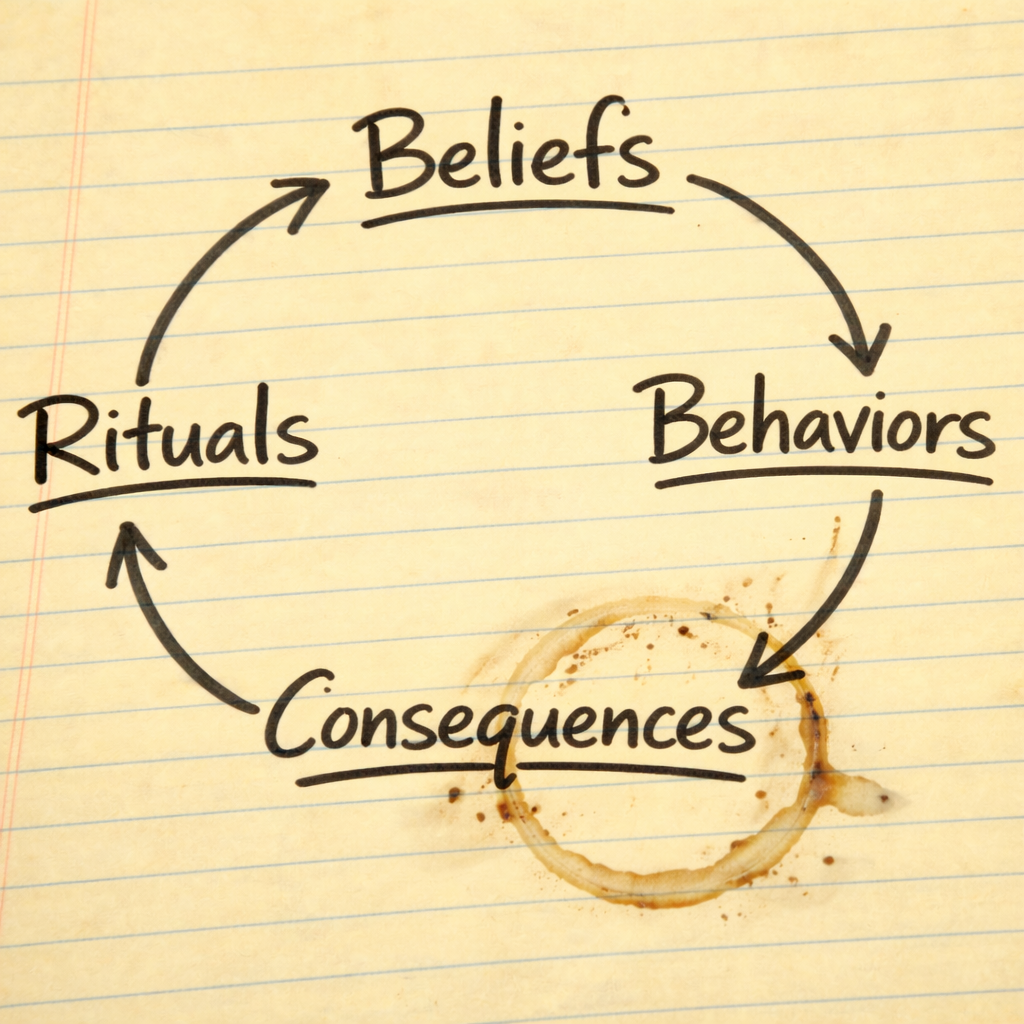
In your book Premeditated Culture, you focus on four elements of a defined culture cycle. I was always taught that the first step for intentional culture is to focus on and define our belief system. That’s where mission and vision statements come from. You seem to jump right to behaviors.

Response:
Beliefs are invisible, assumptions are invisible, the way we see the world is invisible. Even people inside an organization often struggle to describe the beliefs that actually drive their decisions. They can usually recite the mission statement hanging in the lobby, but that’s not necessarily the belief system that governs their work.

Behavior is different.  Behavior is observable.  I don’t spend much time listening to what organizations say about themselves. I watch what they do.

But even behaviors can be misleading. Some behaviors survive. Others disappear because reality has a way of sorting good ideas from bad ones. The consequences of our decisions determine which behaviors become habits and which are abandoned.

The behaviors that survive become customs and rituals. We repeat them. We tell stories about them. We celebrate them. We teach them to new employees.

Eventually those rituals reinforce the very beliefs that produced the behaviors in the first place.

The culture cycle begins with beliefs.  But culture analysis begins with behaviors.

If you want to understand an organization’s culture, don’t start with its mission statement.  Start by watching what management consistently rewards, tolerates, and repeats.

Everything else follows.

IKEA and Their Furniture (Store)

Strategic decisions drive the culture. Beliefs drive behavior.

Most retailers try to make shopping easier.  IKEA moves most of the work onto the customer.  Yet, customers see this as a fair trade-off .

Combine  American sensitivity to price with European minimalism and you have an IKEA store. IKEA created a strategy that reduced the cost structure that customers saw as a reasonable value proposition. Entering the store, customers are handed a pick ticket used by the warehouse to pull the selected item from inventory. The journey through the store, in a maze of lines on the floor, requires the customer to consider featured items in a process to build the purchase ticket. The path isn’t simply about navigation. It is designed to expose customers to ideas they weren’t planning to buy.

Manicured assembly instructions complete the trade, customers are willing to self-assemble in exchange for a more reasonable price. The instructions are part of a carefully flat packed item designed to fit inside most every American automobile. Delivery may be available, but the strategy is to get it all in the customer vehicle and get them on their way. IKEA intentionally leaves the final steps of manufacturing and delivery to the customer. In return, the customer receives a lower price.  Assembly and last mile logistics are not part of the IKEA business model.

IKEA isn’t successful because it sells inexpensive furniture.  It succeeds because management believed customers would willingly trade convenience for value.  The store, the warehouse, the flat-pack box, the assembly instructions—even the maze through the showroom—are simply observable behaviors flowing from that single belief.

Two cultures, minimalism and price sensitivity, meet inside of a business model that endures. It’s the way we see the world.

Just One Thing

“But, if Herb Kellerher’s mindset was the difference in Southwest’s success, the open seating, the free bags, why did Southwest abandon those things?” Christopher pushed back.

“What makes you think they abandoned them?” I asked.

“Now, they have assigned seating, they charge for bags,” he paused. “They are starting to look like every other airline.”

“Those are behaviors,” I nodded. “What do behaviors usually tell us?”

“That something underneath has changed,” Christopher said.

“You know, your question may be more interesting than the answer,” I replied. “Let’s look at your question. You observed the system that created Southwest and now you see it has abandoned those very things. You traced their success to a mindset, to a belief about Southwest’s place in the airline industry, more specifically about their place in the transportation industry. What change must have occurred in the mindset of Southwest, specifically the current board of directors to cause them to abandon their historic operational differences?”

“Did they start losing money?” Christopher wanted to know.

“You’re a smart guy, with a phone. Look it up,” I instructed.

Christopher was a smart guy and thirty seconds later had his answer. “They lost money during COVID, but so did everyone else.”

“And then?” I prompted.

“And then they made money. And the year after, and the year after, they made money every year.”

“So, they weren’t going bankrupt?” I assured him. “What management beliefs produce almost 47 consecutive years of net profit where every other airline is subject to down cycles?”

Christopher sat with the question. “I can’t see the beliefs,” he said. “All I can see are the pieces of a coherent system. One type of aircraft, fast gate turns, secondary airports, low fares, free bags, open seating. Every one of those things fits together.”

“And what happens when you change just one thing?” I asked.

Christopher didn’t hesitate. “It doesn’t just change one thing.”
What Do They Believe?

“We have plenty of time to fight fires,” Jonas complained, “but never any time to make a plan of attack and everyone pull their weight. We are a bunch of individuals doing our own thing without the total picture perspective. We are the managers in the business. But we don’t manage, we fight the next fire, sometimes of our own creation. When other managers are not concerned with how their tactics affect the next process in line, the culture will not change. It’s a culture of, now that my part is done, I wash my hands of the problem and pass it along to the next manager to deal with. No ownership of the problem, so, no solution that benefits everyone. How can the culture change when the people in the culture don’t want to change?”

“That’s quite an analysis,” I replied. “And, probably accurate. As you watch this going on, what do you think is going through the minds of your management team? What do they believe? What are they trying to protect?”

“That’s easy,” Jonas said. Here is a list.

  • The most important thing around here is not to get blamed for anything.
  • The most important thing around here is to make sure, if you make a mistake, it does not get connected back to you, that someone else can be blamed.
  • The most important thing around here is that if you make a mistake, make sure it cannot be discovered in your work area, or your part of the process.

“So, are you surprised?” I asked. “If that is what they believe, why would they behave any differently? You cannot change the behavior until you change the belief.”

Premeditated Culture is now available at Amazon.

It’s What People Believe

“People have a fair, intuitive sense of their own capability,” Pablo said. “And, they yearn for opportunity to exercise their full potential. To do otherwise causes people to wilt. A great deal of a person’s self-esteem, even identity, comes from the value they see in the work that they do.”

“So, the system in which they work has impact on how they behave?” I floated.

“It’s not just the system, it’s what people believe about the system. What we believe, our assumptions, the way we see the world is what drives our behavior. Look, the real question is, if we believe that people want to fully participate at their highest level of capability, spread their wings toward independence, that they do not need a carrot and stick to get on with their work, then what kind of managerial system would we create?”

“This sounds a bit idealistic, don’t you think?” I countered.

“Not at all,” Pablo replied. “This is about hard nosed work. Making decisions and solving problems, tough decisions and difficult problems.”

Infectious

“You said, being a victim is a mental state?” Carson wanted to explore.

“Yes, it can even be more pervasive,” I replied. “There is a continuum – a mood, which is temporary, to a mental state, or a prolonged mood, to the way we see the world, a belief, which is longer term, persistent, base on a thought we think over and over. Moods are easy to change with ice cream. A mental state, not so much. And beliefs become ingrained, not permanent, but doggedly stubborn.”

“And infectious,” Carson flatly stated.

“How so?” I asked.

“I can have a teammate in a mood, less say, not so positive, bordering on negative. That mood influences other teammates, mostly at the water cooler. ‘You wouldn’t believe what happened to me on the way to work today. This guy cut me off in traffic, almost crashed my car’.”

“And, now you get a better story from someone else, and on it goes, until it creates a mental state for the whole team,” I smiled.

“What’s worse, the team now has to solve a real work problem from a triggered state. And, the real problem becomes the vehicle of bad luck, for which the team has no accountability.”

“It’s a cycle,” I nodded. “How do you interrupt the cycle? How do you, as a manager, shift the mental state of the team?”

Comfort Zone

“But, the ringleader of the team doesn’t believe in the project. As long as that is what she believes, the project is doomed,” Ryker explained.

“What are your alternatives?” I asked. “And, I am looking for more than one.”

Ryker thought a bit. “I could try to change what she believes. That’s one. I could try to change her influence over the team, find a new ringleader. Or, it might just be easier to resign the project, let it go.”

I nodded. “Yes, it would be easier to abandon the project, stay in your comfort zone.”

Ryker pursed his lips. Seconds ticked by. “Nope, not going to abandon.”

“Okay, then,” I stared at Ryker. “Then, tell me what you are going to do.”

Quickest Way to Change Company Culture

“What’s the quickest way to change your culture?” Pablo asked.

“Great question,” I replied. “Shifting culture usually takes time and intention.”

“But, there is a way,” Pablo nodded.

“Is this a trick question?” I wanted to know.

Pablo continued to nod. “It’s not a trick, but it’s generally not where you look. The quickest way to change your culture, is to bring in new people. They bring a culture with them.”

I smiled.

“Unfortunately,” Pablo continued, “that culture they bring with them may be counter to the culture you intend. If, based on surveys, we find that most people are disengaged at work, then I assume most companies have cultures that are disengaging. In companies where people feel undervalued, underutilized, not challenged, team members will engage in coping behaviors that may be counterproductive. They quit, and get hired by you. Guess what assumptions they bring with them? And, that is where culture starts, with their assumptions, their beliefs, the way they see the world. Your initial employee orientation may be the most important time they spend to ensure they understand the new culture they will become a part of.”

Underpinnings of Theory

“I have to tell you,” I started. “I have a high bias for action. Theory is okay, but for me, I am more interested in real world application, the theory, not so much.”

Pablo gave me a short grimace. “Unfortunate,” he said. “I know you young people are short on attention, you look for excitement in the world. Often, the underpinnings of theory escape you.”

“It’s not that,” I defended. “I just lean toward doing something.”

“I am sure that is what you believe, but every action you take, indeed, all of your behavior is based on your perception of the world, what is going on around you. Understand, that perception is always a frame of some sort. There are things within your field of vision, and things outside your field of vision. Sometimes, to change your frame, all you have to do is turn your head.”

“I get that,” I nodded. “I’m a visual person.”

“Most of your frames,” Pablo turned his head to see me sideways, “are not visual frames, but mental frames. Your mental frames are based on assumptions, beliefs, the way you see the world. Most of your frames are based on some theory. And, if your theory is not intentional, studied, tested, then your behavior may be (mis)guided by a theory of which you are not aware.”

How Does Culture Drive Behavior?

“He doesn’t fit the culture,” Ruben explained. “Jason’s okay, knows the technical side of the business, but he doesn’t fit the culture.”

“What do you mean, he doesn’t fit the culture?” I asked.

“He doesn’t fit the team,” Ruben replied. “Our teams work together, support each other, help each other. If someone asks Jason a question, he snaps the answer, he treats the other person like they are stupid. And, they just want to know the answer to the question.”

“What does Jason believe about the team?”

“What do you mean, believe about the team?” Ruben looked puzzled.

“You said this was a culture problem,” I nodded. “Culture is a set of beliefs that drive behavior, for better or worse. Ultimately, those behaviors are repeated and become an unwritten set of rules that guide the team in the way they work together. That’s culture. But, it all starts with what we believe, what you believe, as the manager, what Jason believes as a team member. If you want to change the behavior, you have to change the context. What we believe, what Jason believes, creates the context and drives his behavior. What does Jason believe about the team?”

Ruben looked up into his brain, “Jason believes he is smarter than anyone else on the team. Jason believes that he could do all the work better than anyone else on the team. Jason believes the other people on the team slow him down. When someone asks a question, it proves Jason is right, that he is the smartest person on the team and he wants everyone to know it.”
______
Our online program, Hiring Talent kicks off Jan 15, 2016. More information here.