Tag Archives: rituals

What We Tolerate

“But I want this place to feel like a family. I want people to feel warm inside when they think about our company. That’s the kind of culture I want to create,” Tracy explained.

“First, I can’t see what someone thinks,” I replied. “I can only see behavior. Culture may impact the way we feel, but culture drives behaviors. Culture starts with beliefs, but even beliefs are invisible. Tell me what people do, and it will give you insight into what they believe.”

“I should look at behaviors?” she wanted to know.

I nodded. “For example, let’s say we want to focus on safety, we want to create a safety culture. This is not your warm and fuzzy culture feeling, but a belief that every team member goes home each and every day with ten fingers and ten toes. If that is what we believe, what behaviors does that drive?”

“That they wear safety glasses, steel toed shoes,” she said. “That they watch for unsafe work practices. They watch perimeters, safety walk equipment, pay attention to balanced loads. Most important, watch out for each other.”

“So, you have a whole series of behaviors connected to ten fingers, ten toes,” I smiled. “What if your best technician shows up in tennis shoes? You see, behaviors get tested by reality. You don’t stand for the aspiration, you stand for what you tolerate.”

“Our best technician does not get a pass,” Tracy was firm. “He goes home, gets the right work boots.”

“And those behaviors that survive the test of reality become our customs and rituals. Daily safety huddles, site specific safety exposure meetings, maintained safety equipment, those become rituals. And those rituals reinforce what we believe – ten fingers, ten toes.”
Premeditated Culture – Consequences of What We Tolerate is now available on Amazon.

COVID-19 is Shattering Your Culture

Culture is that unwritten set of rules that governs our required behavior, in the work that we do together. If it was written rules, that would be your standard operating procedures. Culture is largely unwritten.

It’s all about behavior. Of course there are ideals, beliefs and assumptions we hold that drive those behaviors, but culture is all about behavior.

Culture (ideals, beliefs and assumptions) are reinforced through customs and rituals. COVID-19 is shattering your culture, throwing you out of your rhythm. Look at your customs and rituals. Perhaps, now is the time to double-down on your customs, examine your rituals. What are you doing to hold your team together?

How We Get to Customs and Rituals

Some time ago, writing a role description, I added Culture as a Key Result Area. What is the accountability of a manager in the Key Result Area (KRA) of Company Culture?

There are several frames in which to look at company culture. The one I currently kick around is –
That unwritten set of rules that governs our required behavior in the work that we do together. It is an unwritten set of rules in contrast to our written set of rules, policies, procedures. And, culture is often more powerful than any policy we may write or attempt to officially enforce. Sometimes, culture even works against our stated policy.

What is the accountability of a manager in the Key Result Area (KRA) of Company Culture?

  • What is the source of culture, where does it start?
  • How is culture visible, how do we see it?
  • How is culture tested?
  • How is culture institutionalized, reinforced and perpetuated?

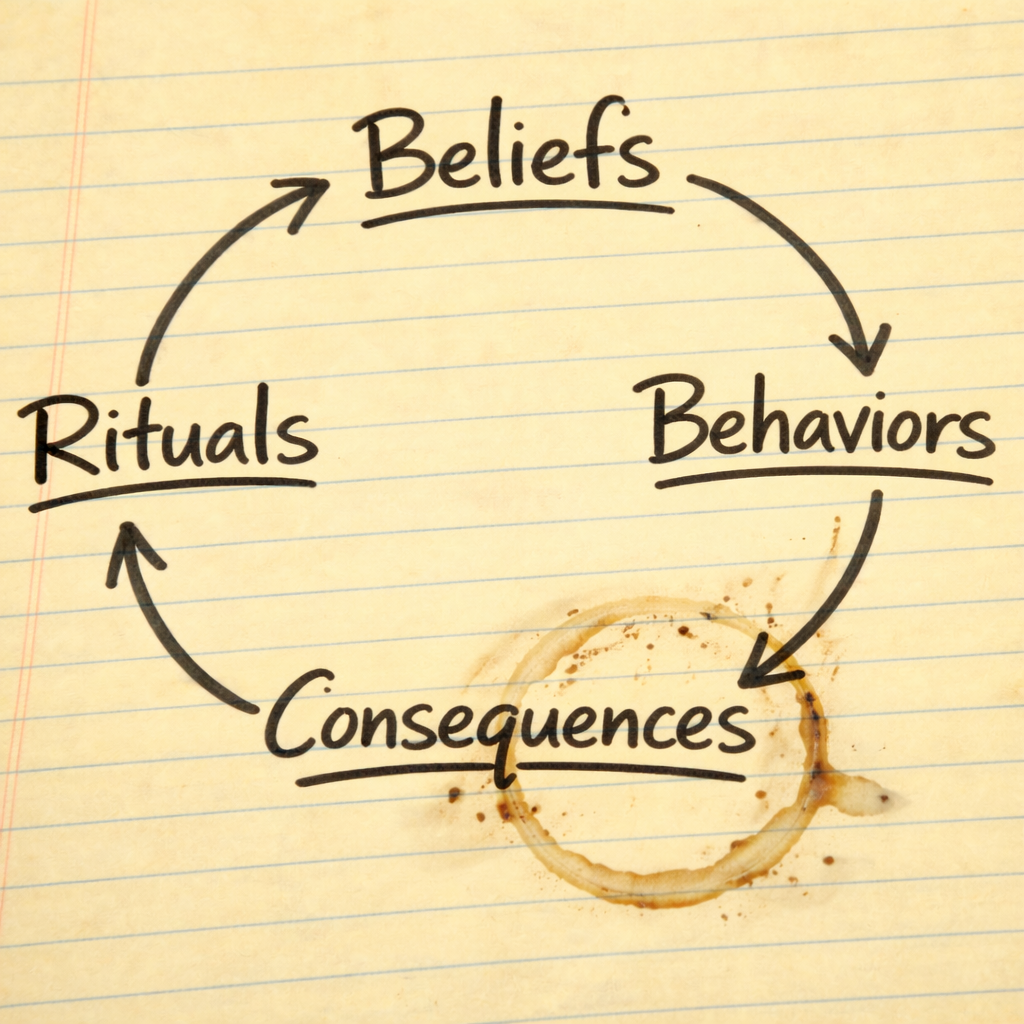
These are the four questions in the Culture Cycle.

Culture Starts
The source of culture is the way we see the world. It includes our bias, our experience, our interpretation of our experience. Culture is the story we carry into our experience that provides the lens, the frame, the tint, the brightness or darkness of that story.

Culture is Visible
Culture, the way we see the world drives our behavior. We cannot see the bias in others. We cannot see their interpretations of the world. We cannot see the story people carry in their minds, but, we can see behavior. Culture drives behavior. Behavior makes culture visible.

Tested
Behavior, driven by culture, is constantly tested against the reality of consequences. For better or worse, behaviors driven by culture are proven valid, or not. Our culture stands for what we tolerate. This is counter to the notion of the lofty intentions of honesty and integrity. Our culture stands for the behaviors we tolerate.

Customs and Rituals
Behaviors that survive, for better or worse, are institutionalized in our rituals and customs. This ranges from the peer lunch on a team member’s first day at work (for better), to the hazing in a fraternity house (for worse). But, it all starts with the way we see the world. -Tom Foster

Culture, Munoz and United

Because I occasionally fly United Airlines, I received an email from Oscar Munoz, CEO at United Airlines that illustrates an often missed step in the culture cycle. Here is what he said in his email, “Earlier this month, we broke that trust when a passenger was forcibly removed from one of our planes. It happened because our corporate policies were placed ahead of our shared values. Our procedures got in the way of our employees doing what they know is right.”

So, here is the culture cycle. Pay close attention to step 3.

  1. We hold beliefs and assumptions, about the way we see the world.
  2. We connect behaviors to those beliefs and assumptions.
  3. We test those behaviors against the reality of consequences.
  4. The behaviors that survive the test become our customs and rituals.

We can say we hold values of integrity, honesty, fairness. We can even define behaviors connected to those beliefs like courtesy, listening, understanding another’s viewpoint. But, somewhere along the line, for the crew on that United Airlines flight, they had learned that NOT following the rules ended in a reprimand. They attempted to displace four passengers for four crew trying to meet a schedule in another city. That was the rule. Had they not followed the rule, they knew there would be hell to pay, a write-up in their employee file, a graveyard shift, a demotion or skipped promotion. They knew that defined behavior of courtesy would never stand up against the reality of consequences.

So, someone got dragged out the door. Based on the settlement with the passenger, it would have been cheaper to purchase four Tesla automobiles for each of the four flight crew and ask them to drive instead of displacing the four passengers.

And right about now, every employee at United Airlines is confused about what to do in spite of what Munoz says.