Tag Archives: consequences

It’s What You Believe

“What do you mean, change the context?” Ruben asked.

“Jason is the smartest guy in the room, or, at least, he wants you to think that,” I nodded. “Right now, his attitude is counterproductive. So, change the context. You do some internal training, from time to time?”

“Yes, but that’s my job,” Ruben assured me.

“No, that’s what you believe. You believe that’s your job. What if you believed it was Jason’s job?”

“But, our internal training is usually about something new, not like we have a training manual, I have to figure how a process works and then determine the best way to teach it,” he protested.

“Sounds like you need the smartest guy in the room. What if you believed it was Jason’s job to teach? Change the context, behavior follows.”

Smartest Person

“He doesn’t fit the culture,” Ruben explained. “Jason’s okay, knows the technical side of the business, but he doesn’t fit the culture.”

“What do you mean, he doesn’t fit the culture?” I asked.

“He doesn’t fit the team,” Ruben replied. “Our teams work together, support each other, help each other. If someone asks Jason a question, he snaps the answer, he treats the other person like they are stupid. And, they just want to know the answer to the question.”

“What does Jason believe about the team?”

“What do you mean, believe about the team?” Ruben looked puzzled.

“You said this was a culture problem,” I nodded. “Culture is a set of beliefs that drive behavior, for better or worse. Ultimately, those behaviors are repeated and become an unwritten set of rules that guide the team in the way they work together. That’s culture. But, it all starts with what we believe, what you believe, as the manager, what Jason believes as a team member. If you want to change the behavior, you have to change the context. What we believe, what Jason believes, creates the context and drives his behavior. What does Jason believe about the team?”

Ruben looked up into his brain, “Jason believes he is smarter than anyone else on the team. Jason believes that he could do all the work better than anyone else on the team. Jason believes the other people on the team slow him down. When someone asks a question, it proves Jason is right, that he is the smartest person on the team and he wants everyone to know it.”

They Admitted Their Pizza Was Terrible

How did the joke go? When you finished eating the pizza, you could eat the box, because it tasted about the same. Unfortunately for Domino’s, customers weren’t joking. By 2008, customer research confirmed what many people already believed.

Patrick Doyle arrived as CEO and admitted as much about the cardboard box. They used real customer testimonials to support the claim about the cardboard. This story isn’t about the remaking of a pizza recipe. The real story is what did Patrick Doyle have to believe to publicly admit the findings of their internal customer surveys?

Customers didn’t suddenly trust Domino’s because the pizza improved. They trusted Domino’s because the company admitted it had a problem. The new recipe simply made that honesty believable.

Translate that shift in management belief to observable behaviors.

  • Publicly acknowledged the problem.
  • Changed the recipe.
  • Invited criticism instead of hiding from it.
  • Invited customers to judge their pizza again.

Most companies believe their job is to protect the brand. Patrick Doyle appeared to believe something different. “Protect the customer’s trust.”

What would your company have to admit before customers trusted you more?

Start With Behaviors

From the Ask Tom mailbag –

Question:
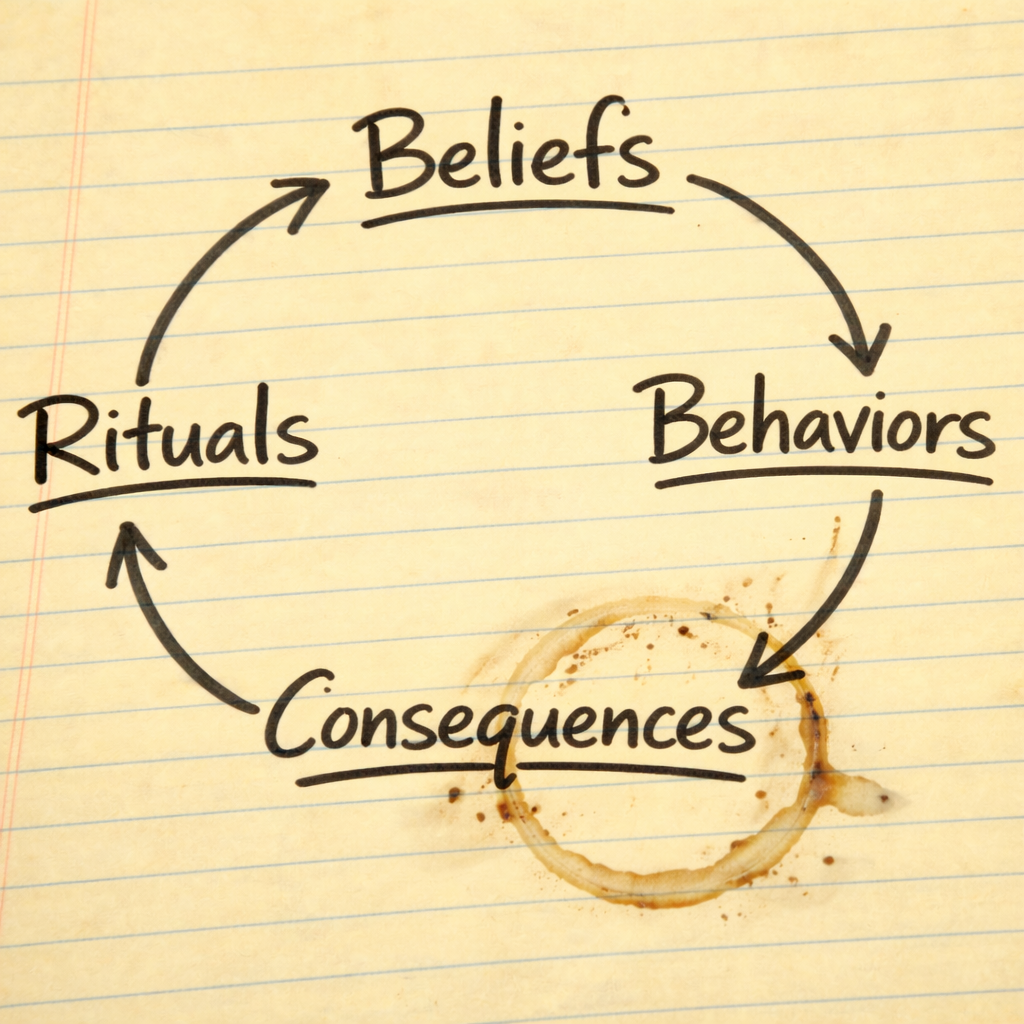
In your book Premeditated Culture, you focus on four elements of a defined culture cycle. I was always taught that the first step for intentional culture is to focus on and define our belief system. That’s where mission and vision statements come from. You seem to jump right to behaviors.

Response:
Beliefs are invisible, assumptions are invisible, the way we see the world is invisible. Even people inside an organization often struggle to describe the beliefs that actually drive their decisions. They can usually recite the mission statement hanging in the lobby, but that’s not necessarily the belief system that governs their work.

Behavior is different.  Behavior is observable.  I don’t spend much time listening to what organizations say about themselves. I watch what they do.

But even behaviors can be misleading. Some behaviors survive. Others disappear because reality has a way of sorting good ideas from bad ones. The consequences of our decisions determine which behaviors become habits and which are abandoned.

The behaviors that survive become customs and rituals. We repeat them. We tell stories about them. We celebrate them. We teach them to new employees.

Eventually those rituals reinforce the very beliefs that produced the behaviors in the first place.

The culture cycle begins with beliefs.  But culture analysis begins with behaviors.

If you want to understand an organization’s culture, don’t start with its mission statement.  Start by watching what management consistently rewards, tolerates, and repeats.

Everything else follows.

Is Paying Attention a Skill?

“Meeting, after meeting, after meeting,” Addison lamented. “If it’s not a meeting about this, it’s a meeting about that.”

“Management is about meetings,” I replied. “If you stood back from all the meetings your company has, what is the big subject area for most?”

“That’s easy,” she nodded. “Most meetings are about some shortfall, some underperformance, a debrief on why something went wrong, a meeting to fix something next time. If you listed all the meeting subjects, you would think we were a company of incompetent stooges.”

“When there is a meeting about underperformance, how would you characterize the conversation?” I asked.

“Again, that’s easy. It starts by looking for the reason why. It ends up attempting to blame someone or some thing. It gets defensive right away, everyone CYA. No real accountability for the consequence.”

“You described the play as a group of incompetent stooges. Setting aside the stooge part, is it a problem of competence?” I wanted to know.

“Yes, you could say it that way,” Addison stopped her thought. “The blame conversation usually describes someone not paying attention, or someone skipping a step, or someone too lazy to double-check. But, I don’t know if its just an unwillingness to pay attention, or a lack of skill in paying attention.”

“Is there a skill in paying attention?”

“If you break it down,” she explained. “What should catch your attention? How often do you pay attention? What distracts you from paying attention? How do you know when you are paying attention?” A few seconds of silence lingered. “We train on the steps. We train on the sequence. We train on the quality standard. But, we never train on paying attention. And, not paying attention causes most of our problems.”
Long Term Consequence

“Clarity, competence, habits, conscientiousness. There’s more?” Mariana asked.

“I told you that making performance necessary was not a simple sleight of hand, or even a hat trick of three,” I said.  “The most powerful element of necessity is consequences. And, I am not talking about pizza for the team for a job well done. Necessity becomes a part of a person’s life.  Long term consequences. Over a decade, the difference in a person’s life has to do with clarity of aim, competence to perform, positive habits that build momentum and conscientiousness to persist toward the goal, in spite of obstacles. That difference is the consequence that matters in our quality of life.

“For you, as a leader, you must surround yourself, build your team with people who see performance as necessary. Not only for your goals, but for their own personal aspirations.”

Consequence

Victoria was stumped. She had always thought the only way to motivate people was to create a bonus or incentive program.

“So, if a bonus is off the table,” I started, “what could you create as a positive consequence?”

“I suppose, if I am around and notice something good, I could give them an attaboy,” she floated.

“And if you are not around?”

“That’s the problem, when I’m not around, things grind to a halt.”

“Have you ever heard, What gets measured, gets done?” I asked. “Why do you think that happens?”

“I don’t know. I suppose it’s because people think they are being watched even when they aren’t being watched.”

“Don’t be naive. People know exactly when they are being observed and when they’re not. Here’s why What gets measured gets done. Knowing that something was done correctly, one unit completed to the quality standard creates a positive consequence. But only if it was measured. If no one notices, then there is no positive consequence. If it gets measured, there is a positive consequence.”

“So, then I would still have to be there to count all the completed units?” Victoria resisted.

“No, they’re adults. They can count their own completed units, and post the number on the white board by their work station.”

“What white board?” Victoria asked.

“The one you are going to purchase and put up tomorrow.”

Culture, Munoz and United

Because I occasionally fly United Airlines, I received an email from Oscar Munoz, CEO at United Airlines that illustrates an often missed step in the culture cycle. Here is what he said in his email, “Earlier this month, we broke that trust when a passenger was forcibly removed from one of our planes. It happened because our corporate policies were placed ahead of our shared values. Our procedures got in the way of our employees doing what they know is right.”

So, here is the culture cycle. Pay close attention to step 3.

  1. We hold beliefs and assumptions, about the way we see the world.
  2. We connect behaviors to those beliefs and assumptions.
  3. We test those behaviors against the reality of consequences.
  4. The behaviors that survive the test become our customs and rituals.

We can say we hold values of integrity, honesty, fairness. We can even define behaviors connected to those beliefs like courtesy, listening, understanding another’s viewpoint. But, somewhere along the line, for the crew on that United Airlines flight, they had learned that NOT following the rules ended in a reprimand. They attempted to displace four passengers for four crew trying to meet a schedule in another city. That was the rule. Had they not followed the rule, they knew there would be hell to pay, a write-up in their employee file, a graveyard shift, a demotion or skipped promotion. They knew that defined behavior of courtesy would never stand up against the reality of consequences.

So, someone got dragged out the door. Based on the settlement with the passenger, it would have been cheaper to purchase four Tesla automobiles for each of the four flight crew and ask them to drive instead of displacing the four passengers.

And right about now, every employee at United Airlines is confused about what to do in spite of what Munoz says.