Tag Archives: behavior

Start With Behaviors

From the Ask Tom mailbag –

Question:
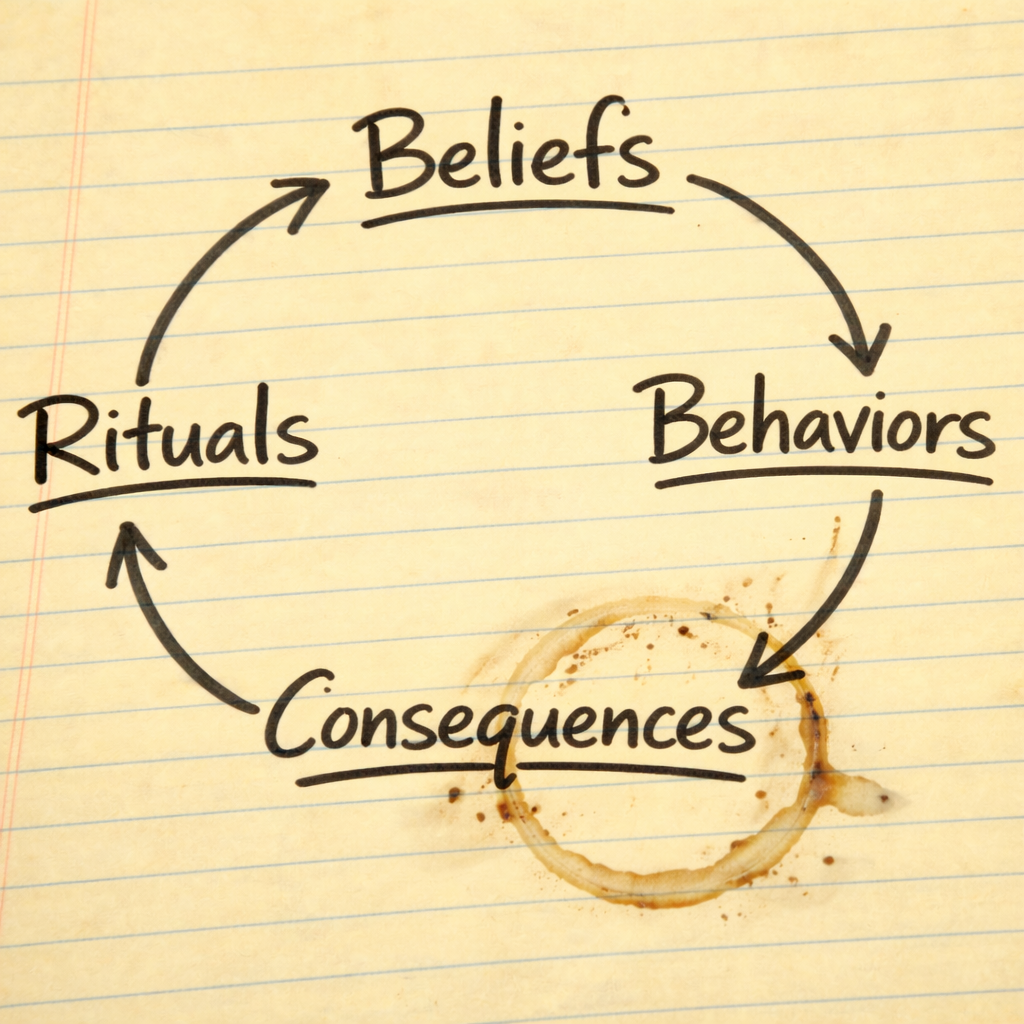
In your book Premeditated Culture, you focus on four elements of a defined culture cycle. I was always taught that the first step for intentional culture is to focus on and define our belief system. That’s where mission and vision statements come from. You seem to jump right to behaviors.

Response:
Beliefs are invisible, assumptions are invisible, the way we see the world is invisible. Even people inside an organization often struggle to describe the beliefs that actually drive their decisions. They can usually recite the mission statement hanging in the lobby, but that’s not necessarily the belief system that governs their work.

Behavior is different.  Behavior is observable.  I don’t spend much time listening to what organizations say about themselves. I watch what they do.

But even behaviors can be misleading. Some behaviors survive. Others disappear because reality has a way of sorting good ideas from bad ones. The consequences of our decisions determine which behaviors become habits and which are abandoned.

The behaviors that survive become customs and rituals. We repeat them. We tell stories about them. We celebrate them. We teach them to new employees.

Eventually those rituals reinforce the very beliefs that produced the behaviors in the first place.

The culture cycle begins with beliefs.  But culture analysis begins with behaviors.

If you want to understand an organization’s culture, don’t start with its mission statement.  Start by watching what management consistently rewards, tolerates, and repeats.

Everything else follows.

IKEA and Their Furniture (Store)

Strategic decisions drive the culture. Beliefs drive behavior.

Most retailers try to make shopping easier.  IKEA moves most of the work onto the customer.  Yet, customers see this as a fair trade-off .

Combine  American sensitivity to price with European minimalism and you have an IKEA store. IKEA created a strategy that reduced the cost structure that customers saw as a reasonable value proposition. Entering the store, customers are handed a pick ticket used by the warehouse to pull the selected item from inventory. The journey through the store, in a maze of lines on the floor, requires the customer to consider featured items in a process to build the purchase ticket. The path isn’t simply about navigation. It is designed to expose customers to ideas they weren’t planning to buy.

Manicured assembly instructions complete the trade, customers are willing to self-assemble in exchange for a more reasonable price. The instructions are part of a carefully flat packed item designed to fit inside most every American automobile. Delivery may be available, but the strategy is to get it all in the customer vehicle and get them on their way. IKEA intentionally leaves the final steps of manufacturing and delivery to the customer. In return, the customer receives a lower price.  Assembly and last mile logistics are not part of the IKEA business model.

IKEA isn’t successful because it sells inexpensive furniture.  It succeeds because management believed customers would willingly trade convenience for value.  The store, the warehouse, the flat-pack box, the assembly instructions—even the maze through the showroom—are simply observable behaviors flowing from that single belief.

Two cultures, minimalism and price sensitivity, meet inside of a business model that endures. It’s the way we see the world.

What Do They Believe?

“We have plenty of time to fight fires,” Jonas complained, “but never any time to make a plan of attack and everyone pull their weight. We are a bunch of individuals doing our own thing without the total picture perspective. We are the managers in the business. But we don’t manage, we fight the next fire, sometimes of our own creation. When other managers are not concerned with how their tactics affect the next process in line, the culture will not change. It’s a culture of, now that my part is done, I wash my hands of the problem and pass it along to the next manager to deal with. No ownership of the problem, so, no solution that benefits everyone. How can the culture change when the people in the culture don’t want to change?”

“That’s quite an analysis,” I replied. “And, probably accurate. As you watch this going on, what do you think is going through the minds of your management team? What do they believe? What are they trying to protect?”

“That’s easy,” Jonas said. Here is a list.

  • The most important thing around here is not to get blamed for anything.
  • The most important thing around here is to make sure, if you make a mistake, it does not get connected back to you, that someone else can be blamed.
  • The most important thing around here is that if you make a mistake, make sure it cannot be discovered in your work area, or your part of the process.

“So, are you surprised?” I asked. “If that is what they believe, why would they behave any differently? You cannot change the behavior until you change the belief.”

Premeditated Culture is now available at Amazon.

Broccoli and Power

“So how do I get my team to the point where they believe in what is necessary? How do I make them believe?” Erica was stumped.

“Indeed,” I said. “If your team doesn’t believe it is necessary, you cannot make them believe. Sure, you can trick them with a bonus or maybe a plaque, but it is still a trick.”

“Like your broccoli story,” Erica remembered, “I have the authority as a parent to command broccoli, but my child has the power to determine if broccoli will be eaten?”

“Yes,” I nodded. “If you feel the need to compel behavior, does that say anything about the power others have over you?”

Thinking, Talking, Doing

“I’m a little disappointed with my team,” Jesse nodded, looking down.

“And?” I asked.

“We were in the meeting, talking about a new method in one step of our production. It’s way faster and prevents the defects we were seeing during that step. I know it seemed strange to the team, but they said they would trust me and do it the new way.”

“And?” I repeated.

“It was like we didn’t even have the meeting. They talk a good game, but what they say and what they do are different. I wish I knew what they were thinking.”

“Does it really matter what they were thinking. My guess is they were thinking you had a new way. They were thinking it seemed strange. But, they were thinking they trusted your new way. Thinking, even talking is no assurance of behavior. If you want insight into someone’s behavior, watch what they do.”

Being Early

Habits can be a double-edged sword. That routine grooved behavior is a shortcut to apply a known solution over and over. But, things change and a known solution to one problem may not fit another problem. Because it worked before and then again, it is easy to misapply a routine grooved behavior to a new problem that doesn’t fit.

If we are looking for unconventional results, applying a known solution, even when it works, may only yield conventional results, same as last time. Always ask what changed.

Some habits avoid the trap. The habit of showing up early rarely has a downside. Showing up early allows for a time of calm before the beginning, to think, mentally rehearse and settle the nerves. Showing up early is a discipline, a habit that is a way of being.

When you find yourself doing something over and over, examine your purpose and your intended outcome to determine if it’s a habit that helps or a habit that is just expedient. Or it could be a habit that always contributes, like being early.

Change or Shift?

“Look,” I said, “if you want to fire this guy, or just cut him off at the knees, you don’t need this. Do this, only if you want to see him correct the misbehavior. Otherwise, just fire him and get it over with. You don’t need me for that.”

“I just don’t see any other way,” Alice stated flatly. “I gave Barry a list of about 15 things he needs to change if he wants to stay on the team.”

“What about the other five that didn’t make the list?” I grinned.

“You’re right, I guess I was piling on.”

“Look, if the solution seems difficult,” my grin disappeared, “what is the likelihood that Barry is going to jump in and make everything right?”

“Not much,” Alice replied.

“If you want to raise the probability that Barry will actually change his behavior, he has to truly believe that the solution will be easy for him. You have to break it down to its simplest terms so he can understand that we are not asking him to scale Mount Everest.”

“So, I need to just pick one thing he needs to change?” Alice said, narrowing her list.

“Instead of asking Barry to change, why don’t we start by asking him to shift. Shift is a lot easier than change.”

The Big Derailer

“Tell me what you accomplished so far with the pattern we talked about?” I asked.

“We met, everybody, same room. I acknowledged the heated exchange between Fred and Jim from the week before, that there was an issue of underperformance on a project. I asked everyone to write down how they felt during the exchange, then once around the table, everyone speaking only for themselves. No one was allowed to say -we all felt this, or most of us felt that, everyone can only speak for themselves,” Ron started.

“Okay,” I nodded. “We know what the issue is, that we are attempting to resolve underperformance on the project. We were clear to acknowledge the emotional load that went with it. Fred and Jim are now aware of the impact of their heat on the team. Now we get curious.”

Ron furrowed his brow. “What do you mean get curious?”

“I mean, questions and only questions,” I said.

“Who is asking the questions and who is responding?” Ron wanted to know.

“Everyone on the team is asking the questions. Fred and Jim get to respond. Here is a quick list –

  • Working on the project, what did you observe? What did you see, what did you hear?
  • What was the impact on the project? What were other impacts on the project? How did that make you feel?”

“Whoa, whoa,” Ron stopped me. “We keep talking about feelings. What do feelings have to do with this?”

“That’s easy. First, it is out in the open that there was underperformance on the project, which is what we are trying to fix. Fixing the problem got derailed by the emotions in the exchange. We can avoid those emotions, we can stuff them down, we can ignore them, but they will come back, they always come back. Let’s get the emotions out on the table now, so we can acknowledge them, check them with reality, so we can get on with fixing the problem.”

What Would Happen?

“But, Sue, Tony and Ricardo were just bystanders in the exchange between Fred and Jim,” Ron was puzzled. “Shouldn’t I keep them as bystanders and just deal with the two primary actors?”

“Sue, Tony and Ricardo are as involved in the fracas as Fred and Jim. They may not have actively participated on the front end of the exchange, but they were certainly impacted on the back end. Fred and Jim need to hear about that. So, yes, everyone gets a turn in the discussion, but, only speaking for themselves. And you, you are not exempt, just because you are the leader. How did you feel when the back and forth between Fred and Jim got heated?”

“I felt threatened, my stomach got a little knot in it,” Ron replied. “I wanted it to be over, I wanted it to stop.”

“And, what else?” I asked.

“I felt like the team was going to explode, or fall apart.”

“And, what else?”

“I felt if Fred and Jim continued their animosity, it might turn violent and they would never be able to work together again.”

“Good,” I said. “I assume you will hear similar things as you go around the table.”

“And, that’s it?” Ron stopped.

“No, now it is time to get curious. What was it that contributed to the heat? Now is the time for questions.”

Quickest Way to Change Company Culture

“What’s the quickest way to change your culture?” Pablo asked.

“Great question,” I replied. “Shifting culture usually takes time and intention.”

“But, there is a way,” Pablo nodded.

“Is this a trick question?” I wanted to know.

Pablo continued to nod. “It’s not a trick, but it’s generally not where you look. The quickest way to change your culture, is to bring in new people. They bring a culture with them.”

I smiled.

“Unfortunately,” Pablo continued, “that culture they bring with them may be counter to the culture you intend. If, based on surveys, we find that most people are disengaged at work, then I assume most companies have cultures that are disengaging. In companies where people feel undervalued, underutilized, not challenged, team members will engage in coping behaviors that may be counterproductive. They quit, and get hired by you. Guess what assumptions they bring with them? And, that is where culture starts, with their assumptions, their beliefs, the way they see the world. Your initial employee orientation may be the most important time they spend to ensure they understand the new culture they will become a part of.”