Tag Archives: culture

The Baton Pass

Pruitt glanced at the other two shareholders with the brief eye contact of a shared understanding. “Documentation discipline,” he said. “Every document is right the first time. Every classification is accurate. Every valuation is current. The customs brokers we use on both sides know our paperwork before it arrives.” He paused. “You’ll want to get to know Carlos. He is our customs broker out of Nogales. He has an office on the US side. It’s his relationship that makes the clearance rate possible. Whatever he needs, he gets it.”

Everyone but Jarrad stood to leave the room. The clock on the wall showed 8:38. Jarrad stood and met their grip like a baton at a relay race. The handshakes were warm, but with a visceral quality of relief, an apology that none of them made explicit. Each finished their segment, it was Jarrad’s turn to be the runner. They escaped what all shareholders escape when they exit. They escaped the routine, the pressure, the obligations. The visible obligations and the hidden obligations now belonged to Jarrad.

Premeditated Culture is now available on Amazon.

Tested by Reality

Folklore has it, the gauntlet was an ancient rite of passage in 18th century France. Each wearing an armored glove, members of the military would stand double line, facing each other, the subject directed down the middle, to receive striking blows from the armored gloves. In an adapted ceremony, tribal lore sent a graduating pubescent male down the line to receive stunning blows from sticks, clubs and rocks. The purpose was not to kill or maim, only to inflict maximum pain. Each participant had once passed through that same gauntlet, branded by the group, now as one of their own.

It was also the opportunity for a hidden rival to lay ambush, exact retribution for a past transgression. The culture of the gauntlet did not punish the ambush. All saw it as a test of character for the brave new warrior.

Premeditated Culture, now available on Amazon.

What We Tolerate

“But I want this place to feel like a family. I want people to feel warm inside when they think about our company. That’s the kind of culture I want to create,” Tracy explained.

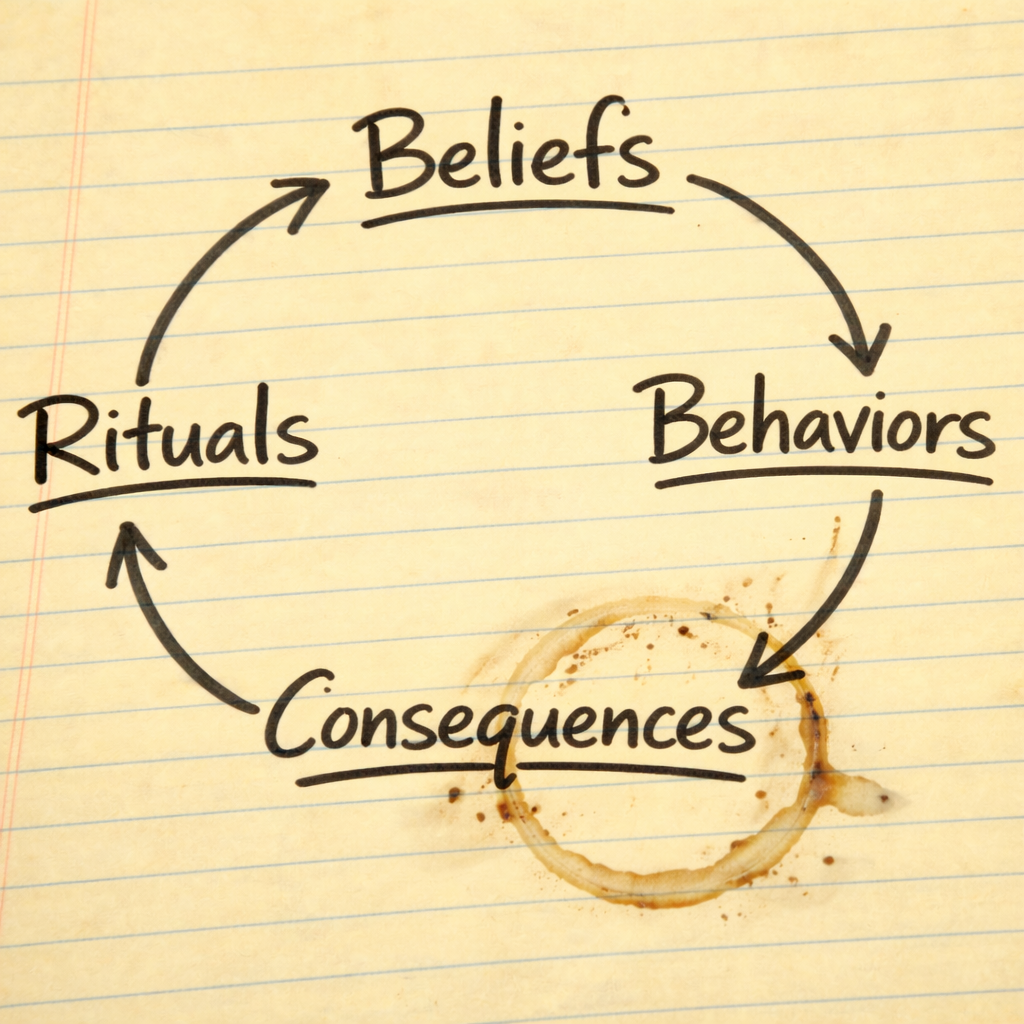
“First, I can’t see what someone thinks,” I replied. “I can only see behavior. Culture may impact the way we feel, but culture drives behaviors. Culture starts with beliefs, but even beliefs are invisible. Tell me what people do, and it will give you insight into what they believe.”

“I should look at behaviors?” she wanted to know.

I nodded. “For example, let’s say we want to focus on safety, we want to create a safety culture. This is not your warm and fuzzy culture feeling, but a belief that every team member goes home each and every day with ten fingers and ten toes. If that is what we believe, what behaviors does that drive?”

“That they wear safety glasses, steel toed shoes,” she said. “That they watch for unsafe work practices. They watch perimeters, safety walk equipment, pay attention to balanced loads. Most important, watch out for each other.”

“So, you have a whole series of behaviors connected to ten fingers, ten toes,” I smiled. “What if your best technician shows up in tennis shoes? You see, behaviors get tested by reality. You don’t stand for the aspiration, you stand for what you tolerate.”

“Our best technician does not get a pass,” Tracy was firm. “He goes home, gets the right work boots.”

“And those behaviors that survive the test of reality become our customs and rituals. Daily safety huddles, site specific safety exposure meetings, maintained safety equipment, those become rituals. And those rituals reinforce what we believe – ten fingers, ten toes.”

Premeditated Culture – Consequences of What We Tolerate is now available on Amazon.

Commitment or Compliance

“If people do their best work in a place where they feel safe, what is it that managers can do to create that space?” I asked.

“We always want to do,” Pablo started. “If managers would only do this, do that, things would be better. It is not so much a matter of what managers do, it is a matter of the relationship between the manager and the team member. Do we have relationships built on dominance, pressure and compliance, or relationships built on trust, cooperation and commitment? Organizational structure is the way we define the working relationships between people.”

“This sounds like culture,” I replied.

“Organizational structure defines the working relationships between people. Organizational structure is culture.”

—New, available soon, on Amazon.  Premeditated Culture, Consequences of What We Tolerate.

Contribution and Culture

“And, to promote the social good for the team employed by my company,” Pablo said, “I have to believe in the good inside each person. I have to create managerial systems that support that belief.”

“What you say is counter to many managerial practices,” I said. “In my travels, I see compensation systems, bonus and incentive programs that rely on greed and competition. I see team members with a narrow focus only on the next promotion, hidden agendas, backdoor politics, even backstabbing. I see a general mistrust of authority inside the company.”

“Yes, often that is what you see,” Pablo replied. “And, it is through no fault of employees. They engage in behavior to survive inside the system in which they live. If we create a system that relies on greed, we will get greedy behavior. If the only way we acknowledge contribution is by status, if the only thing that feeds a person’s self concept is a promotion, then you will get politics based on power. If you want to change the behavior, change the context in which they live.”

Assumptions and Blame

“I’m done with the drama,” Ellie protested. “I try to promote a positive atmosphere around here, but all I get is bullying and backstabbing.”

“Oh, really?” I asked.

“Yes,” she replied. “Everyone seems to scatter for cover when something goes wrong, blaming other people, scooting out from under any accountability.”

“Are you sure this isn’t an isolated incident?” I wanted to know.

“No, this is more like a constant mental state of the team,” Ellie explained. “People position themselves so they always have an out, denying they have any responsibility. The air of blame is so thick you can cut it. You can feel it in the quiet whispers, the general tone of water-cooler talk.”

“I assume this is not organic evolution,” I smiled. “How did things get this way?”

“It started with our continuous improvement process. We were looking for things to improve on. We made a list, or rather I made a list. No one else could come up with anything.”

“Oh, so you’re the culprit,” my smile turned to a grin.

“Don’t lay this at my feet,” Ellie protested. “It’s the team that can’t get their act together.”

“And, you are their manager,” I nodded. “You describe the team as a group of incompetent players. And incompetence always seeks out blame. Competent people are in the game to get better. So, which do you have? Incompetence or competence?”

Ellie sat in silence before she finally spoke. “I knew you were going to pin this on me. You think my team’s behavior is influenced by the way I see them. As competent or incompetent.”

“Yes,” I agreed. “Our assumptions, the way we see the world drives behavior. If you see your team as incompetent, you will drive blaming behavior. If you see your team as competent, you will drive improvement. So, you better find out what they are good at.”

First Assumptions

“What’s the quickest way to change your culture?” I asked.

“Great question,” Hudson replied. “Shifting culture usually takes time and intention.”

“But, there is a way,” I nodded.

“Is this a trick question?” Hudson wanted to know.

I continued to nod. “It’s not a trick, but it’s generally not where you look. The quickest way to change your culture, is to bring in new people. They bring a culture with them.”

Hudson smiled.

“Unfortunately,” I continued, “that culture they bring with them may be counter to the culture you intend. If, based on surveys, we find that most people are disengaged at work, then I assume most companies have cultures that are disengaging. In companies where people feel undervalued, underutilized, not challenged, team members will engage in coping behaviors that may be counterproductive. They quit, and get hired by you. Guess what assumptions they bring with them? And, that is where culture starts, with their assumptions, their beliefs, the way they see the world. Your initial employee orientation may be the most important time they spend to ensure they understand the new culture they will become a part of.”

Fingers, Ten of Them

“What gives?” I asked, one of my favorite diagnostic questions.

“I’m puzzled,” Stephanie replied. “Our training curriculum for this new process seems on par with the rest of our training, but the team just doesn’t seem to get this new routine. I know we introduced some new equipment, including robotics into the work cells, but it doesn’t look that different from other things we are doing.”

“It may look the same to you, but it’s different to them,” I prodded.

“But, we trained them on the new work methods. I just don’t get it.”

“So, do you think they need more training?” I floated.

“I hope not. We have already lost enough productivity with the training they already have. Besides, the training is just the basic stuff. You know, power on, power off, lock-out, tag-out,” she explained.

“Okay, so the team is not going to cut off their fingers. So, what’s your beef?”

“Throughput. Units through the work cell is way down. They were going faster when they were doing things manually,” Stephanie shook her head.

“So, you discovered something about training?” I smiled. “Training only gets the team to minimum performance. What gets the team to maximum performance? You know, besides keeping all their fingers and toes?”

Unofficial Whispers

All kinds of conversations occur about people and behavior in every company. These conversations will take place at the water cooler, the coffee break room, in meetings and in emails. They will occur in official communications and unofficial whispers. All of the conversations drive and document the culture inside the organization.

For the company that has determined its values mindset, actively talking about the positive aspects of people and their contribution (behaviors) is critical. The purpose is to identify those conversations and amplify them so they become the driving force, the tribal history.

These are the conversations that keep us alive. These are the conversations that distinguish one company from the next, one that is struggling and the other that sees success. What does yours sound like?

What a Great Place

“Our culture?” Miguel stopped. “Well, there is the official story, and then there is the truth.”

I smiled. “Well, we all know the story is better than the truth.”

“Yeah, I know,” Miguel continued. “I mean, we try hard. We got the company mission statement posted by the front door. We got the teamwork posters on the wall. We have an employee newsletter, but you know, morale is still in the dumpster.”

“What do you think is the problem?”

“Don’t know. We try to get everybody on board, but the enthusiasm just isn’t there. It’s like they just don’t believe what a great place this is.”

“Who decided it was such a great place?” I asked.

Miguel was puzzled. “What do you mean, nobody really decided.”

“That’s the point. We, as managers, have manufactured the things you describe as culture. The mission statement looks like it came from some Mission Statement book. The teamwork posters were bought out of a catalogue. I have read your employee newsletter and all it talks about is how to make changes in your 401(k) plan and make a claim in the health insurance program. You have the tools to create and communicate your culture, but you are not using them.

“The biggest tool you have is participation. People will support a workplace they help to make.”