Tag Archives: consequences

Is Paying Attention a Skill?

“Meeting, after meeting, after meeting,” Addison lamented. “If it’s not a meeting about this, it’s a meeting about that.”

“Management is about meetings,” I replied. “If you stood back from all the meetings your company has, what is the big subject area for most?”

“That’s easy,” she nodded. “Most meetings are about some shortfall, some underperformance, a debrief on why something went wrong, a meeting to fix something next time. If you listed all the meeting subjects, you would think we were a company of incompetent stooges.”

“When there is a meeting about underperformance, how would you characterize the conversation?” I asked.

“Again, that’s easy. It starts by looking for the reason why. It ends up attempting to blame someone or some thing. It gets defensive right away, everyone CYA. No real accountability for the consequence.”

“You described the play as a group of incompetent stooges. Setting aside the stooge part, is it a problem of competence?” I wanted to know.

“Yes, you could say it that way,” Addison stopped her thought. “The blame conversation usually describes someone not paying attention, or someone skipping a step, or someone too lazy to double-check. But, I don’t know if its just an unwillingness to pay attention, or a lack of skill in paying attention.”

“Is there a skill in paying attention?”

“If you break it down,” she explained. “What should catch your attention? How often do you pay attention? What distracts you from paying attention? How do you know when you are paying attention?” A few seconds of silence lingered. “We train on the steps. We train on the sequence. We train on the quality standard. But, we never train on paying attention. And, not paying attention causes most of our problems.”
Long Term Consequence

“Clarity, competence, habits, conscientiousness. There’s more?” Mariana asked.

“I told you that making performance necessary was not a simple sleight of hand, or even a hat trick of three,” I said.  “The most powerful element of necessity is consequences. And, I am not talking about pizza for the team for a job well done. Necessity becomes a part of a person’s life.  Long term consequences. Over a decade, the difference in a person’s life has to do with clarity of aim, competence to perform, positive habits that build momentum and conscientiousness to persist toward the goal, in spite of obstacles. That difference is the consequence that matters in our quality of life.

“For you, as a leader, you must surround yourself, build your team with people who see performance as necessary. Not only for your goals, but for their own personal aspirations.”

Consequence

Victoria was stumped. She had always thought the only way to motivate people was to create a bonus or incentive program.

“So, if a bonus is off the table,” I started, “what could you create as a positive consequence?”

“I suppose, if I am around and notice something good, I could give them an attaboy,” she floated.

“And if you are not around?”

“That’s the problem, when I’m not around, things grind to a halt.”

“Have you ever heard, What gets measured, gets done?” I asked. “Why do you think that happens?”

“I don’t know. I suppose it’s because people think they are being watched even when they aren’t being watched.”

“Don’t be naive. People know exactly when they are being observed and when they’re not. Here’s why What gets measured gets done. Knowing that something was done correctly, one unit completed to the quality standard creates a positive consequence. But only if it was measured. If no one notices, then there is no positive consequence. If it gets measured, there is a positive consequence.”

“So, then I would still have to be there to count all the completed units?” Victoria resisted.

“No, they’re adults. They can count their own completed units, and post the number on the white board by their work station.”

“What white board?” Victoria asked.

“The one you are going to purchase and put up tomorrow.”

Culture, Munoz and United

Because I occasionally fly United Airlines, I received an email from Oscar Munoz, CEO at United Airlines that illustrates an often missed step in the culture cycle. Here is what he said in his email, “Earlier this month, we broke that trust when a passenger was forcibly removed from one of our planes. It happened because our corporate policies were placed ahead of our shared values. Our procedures got in the way of our employees doing what they know is right.”

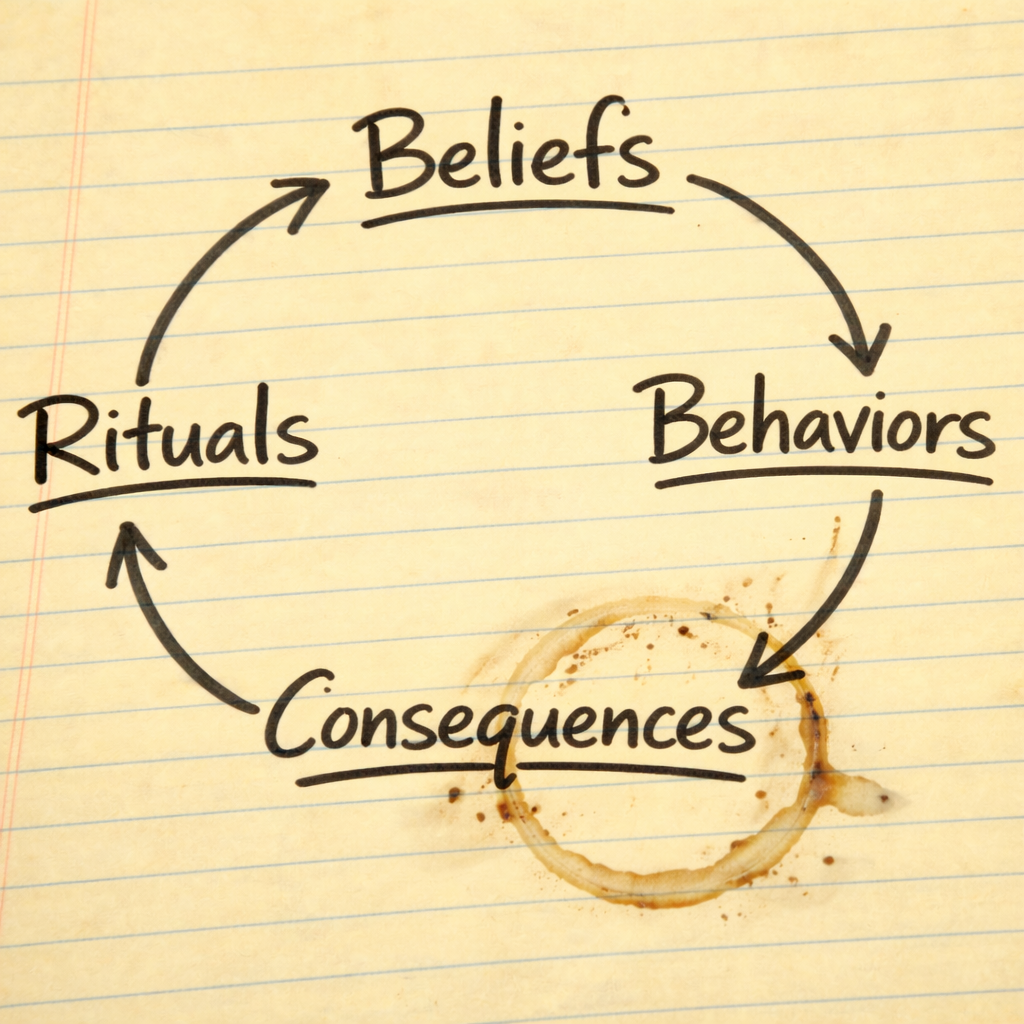
So, here is the culture cycle. Pay close attention to step 3.

  1. We hold beliefs and assumptions, about the way we see the world.
  2. We connect behaviors to those beliefs and assumptions.
  3. We test those behaviors against the reality of consequences.
  4. The behaviors that survive the test become our customs and rituals.

We can say we hold values of integrity, honesty, fairness. We can even define behaviors connected to those beliefs like courtesy, listening, understanding another’s viewpoint. But, somewhere along the line, for the crew on that United Airlines flight, they had learned that NOT following the rules ended in a reprimand. They attempted to displace four passengers for four crew trying to meet a schedule in another city. That was the rule. Had they not followed the rule, they knew there would be hell to pay, a write-up in their employee file, a graveyard shift, a demotion or skipped promotion. They knew that defined behavior of courtesy would never stand up against the reality of consequences.

So, someone got dragged out the door. Based on the settlement with the passenger, it would have been cheaper to purchase four Tesla automobiles for each of the four flight crew and ask them to drive instead of displacing the four passengers.

And right about now, every employee at United Airlines is confused about what to do in spite of what Munoz says.