Tag Archives: manager

The Likelihood of Success

From the Ask Tom mailbag:

Question:
So, how do you interview for someone with the capability to think into the future?

Response:
Capability is like attitude. I cannot interview for attitude and I cannot interview for capability. I can only interview for behaviors connected to attitude and capability.

First, is the capability to think into the future, a requirement for the role? Most supervisory and managerial roles require this capability, so this is a fair area for exploration.

My bias is to ask ONLY questions about the past. I do not want the candidate to speculate or make stuff up. No hypotheticals or theories. I have enough trouble deciphering real facts from the past.

  • Tell me about a time when (my favorite opening question), you worked on a project that took some time to complete, one that required several steps with a number of moving parts?
  • How long did the project take?
  • What was the purpose of the project? The goal for the project?
  • How many people were involved?
  • Step me through the planning process?
  • Was the plan written or just in your head?
  • How was the plan shared with the project team?
  • What was your role in preparing the plan?
  • As the plan was executed, what factors pushed the plan off course?
  • Tell me how the plan accounted for factors that pushed the plan off course?
  • How did the project team respond to changes in the plan?
  • How were decisions made in response to changes in the plan?
  • How did those changes impact the budget for the plan?
  • How did those changes impact the schedule for the plan?
  • How did those changes impact the overall results of the plan?

The responses to these questions will give the interviewer insight into behaviors connected with capability to think into the future, not just think, but make decisions, solve problems, execute into the future? These responses are fact-based and do not require interpretation, yet provide evidence, which can be verified in a cooperative reference check.

The best predictor of future behavior is past behavior. All I have to do, as an interviewer, is to find out how the candidate behaved in the past. There is great likelihood the candidate will behave the same way when they come to work for you.

But, the Candidate Assured Us

“Your new supervisor?” I asked.

“Yes,” Stella explained. “Everyone on the interview team agreed this was the best candidate, but she’s been in the role for two months now, plenty of time for adjustment and it’s just not working out.”

“And this candidate had worked at this level before?”

“Well, not really, but she said she was ready for it. That’s why she was leaving her old job, not enough challenge in it.”

“This is a supervisor position, what’s the time-span of the longest task in the role?”

“Nine months,” Stella replied.

“Tell me about it?” I pulled out a piece of paper to make some notes.

“It’s scheduling,” she continued. “Some of our equipment is very expensive, difficult to get and difficult to move from one job to the next. It can cost us $15,000 just for the riggers to relocate some of the pieces. So we schedule our logistics out six to nine months. And when we schedule it, we stick to plan. Too expensive to do otherwise.”

“And your candidate provided evidence of nine month time span work in the past?”

“Evidence? No, but she assured us she was up to the task.”

Who Creates the Talent Pool?

“In the midst of everything I have to do, with all of my management issues and motivation issues, you expect me to read resumes,” Byron was putting his foot down. “I am a Vice-President in this company. I have other people that read resumes for me.”

I did not respond, just raised an eyebrow. I could see the exasperation on Byron’s face.

“So, just exactly what do I do?” asked Byron. “I mean, I know what to do when I need to hire a manager on my team, but to hire a supervisor on one of my manager’s teams?”

“You won’t make the final selection, but I do hold you accountable for driving this process. Logistically, here is what it looks like. Your division has an opening two strata below you. As the manager-once-removed, it is your accountability to create the talent pool from which the hiring manager will select. Creating the talent pool means that you drive this process. Every morning, when you are fresh, I expect you to come in and spend a half hour to forty five minutes reviewing resumes. That’s every day, whether you have an opening in your division, or not. I expect that each day, you will find two or three resumes that you will find interesting. I expect you to make two or three screening phone calls every day. Once or twice a week, I expect you will actually run across a candidate. If you find only one per week, that is fifty people per year that you might bring in to interview for a supervisor level position.”

“But we have never had fifty people that qualified,” Byron continued to push back.

“Is that the truth, or is that something you believe to be true?”
_________
Hiring Talent, the print version, will be available from Amazon within the week, so we have a new cover. This link is for the Kindle version, available now.
Hiring Talent

Who Makes the Screening Decision?

“So, Byron, tell me again. Irene, your receptionist prints out all the resumes from the job posting. She puts them in two stacks, one out-of-town, one local, checks for two years experience and then delivers them to one of your supervisors.” I was looking at the way Byron was handling resumes for an open position. He was bit dismayed at the lack of quality candidates.

“Yes, the supervisor has been with us for almost two years, so he knows the job and can cull out the unqualified resumes. Then he takes the good ones to the hiring manager. It works pretty well. That way the hiring manager doesn’t have to waste his time,” added Byron.

“You said it works pretty well at saving time for the hiring manager, but it culls out all the quality candidates.” I was baiting Byron.

Byron’s face suddenly flushed. “That’s not what I said. I said there weren’t any quality candidates out there.”

“But you said you culled out the under qualified candidates and the overqualified candidates. Who do you have making those initial decisions?”

Byron could see that I was troubled by the way resumes were initially reviewed. He wanted to respond more positively, but the reality was setting in. “I guess I have my receptionist and a lower level supervisor making those decisions,” he finally replied.

“Should we look at a different approach?”
_____

Just released on Kindle. The only book on hiring that blends the research on levels of work with the discipline of behavioral interviewing. The research on levels of work, pioneered by the late Elliott Jaques, is powerful science. The discipline of behavioral interviewing is the most effective method for its application. This is the only book that puts these two ideas together in a practical framework for managers faced with the hiring decision.
Hiring Talent

Important First Behavior

“I understand positive reinforcement in video games, how you level up to expert, but, how does that work around here?” Travis asked. “I run a loading dock.”

“Travis, the guys loading the trucks, have you noticed the different colored t-shirts they wear, the ones with the company logo on the front?” I asked.

“Yeah, I noticed. We started that about three weeks ago. The new guys get a white t-shirt to start. We had a meeting about it.”

“And when does the new guy get his first white t-shirt?”

“The first day,” Travis smiled.

“No, the first day he punches the time-clock reporting for work on-time,” I clarified. “What is the most important first behavior?”

“Showing up for work on time,” Travis said.

“And when does he get his second white t-shirt?”

Travis was catching on. “The second day he punches in for work on time.”

“And when does he get a yellow shirt?” I continued.

“Five days on time, consecutive days on time.”

“And when does he get a green shirt?”

“When he passes forklift training.” Travis stopped. “I think I get it.”
_____

Orientation for our next program Hiring Talent starts Monday, March 4, 2013. For more information and registration, follow this link – Hiring Talent – 2013.

Bigger Problems to Solve

“It’s new,” said Jeremy. “My role is different. I never thought there was this much difference between being a supervisor and being a manager.”

“What is the biggest change?” I asked.

“I used to have a team of technicians. Now that I am a manager, I have a team of supervisors, each with their own team of technicians. I am no longer coaching technicians on solving problems about production, I am coaching supervisors on the best way to coordinate resources, schedule personnel, order raw material, schedule machines for up-time. I even have to create an annual budget.”

“What else is different?”

“It has to do with time,” Jeremy continued. “I used to think about my team getting the production work done today, or this week. Now, I have to think further into the future, use my imagination to picture what has to happen to get production work done this month, this year, even next year. There are bigger problems I have to solve.”

“And that is why you are no longer a supervisor. Now you are a manager.”
_____

Orientation is over. Next week, we start full bore on Hiring Talent, session one. Still time to sign up. For more information and registration, follow this link, Hiring Talent-2013.

The Difference Between a Supervisor and a Manager

“I was one of the guys, as the team supervisor, now I am their manager,” said Jeremy. “I mean, I know what to do, it just feels weird.”

“Tell me about it.” I asked.

“Well, on Friday, we used to always go out for happy hour. Now, I am holding back. Maybe I will show up once a month after work, but I will usually only stay for one beer, then I beg off and hit the road.”

“What’s changed about the relationships?”

Jeremy took his time to respond. “I guess, instead of being a friend, the relationship was always about the work. I mean, it’s okay to be friendly, but sometimes you have to hold the line, sometimes you have to confront, sometimes the conversation is difficult.” He stopped. “And sometimes you feel by yourself.”

“So, who can you hang out with now?”

“Well, there other managers in the company. They have all been supportive. It is a different perspective. I’m the new kid on the block.”

“And what about your old team, from when you were a supervisor?”

“I am still a manager in that department, but now I work through their new supervisor. My relationship with the team, it’s not accountability anymore, not with me. Now, it’s more like a mentor relationship. It’s a longer view. Instead of me, telling them what to do, I do more observing. Their new supervisor is more concerned with their day-to-day productivity. I am actually looking for the team member that will emerge as the next supervisor in another year.”

“Why do you think all this feels weird?” I ask.

“It’s new,” said Jeremy. “My role is different. I never thought there was this much difference between being a supervisor and being a manager.”
_____
Our online program, Hiring Talent, kicked off its orientation last Friday, but there is still time to jump in on this round. For more information and registration, follow this link, Hiring Talent-2013.

MoRs and Succession

Yesterday, I posted a casual conversation about something I have observed as a fatal flaw in most organizations, the flaw is failing to think forward about succession. The biggest constraint to most companies is the lack of managerial talent. We get so tied up in getting production out the door, we forget about sustaining that momentum beyond the month, the quarter, the year.

In the posted conversation, I did not specifically describe where this accountability lies, nor its mechanics. In short order, I received an email from a colleague, clarifying the situation.

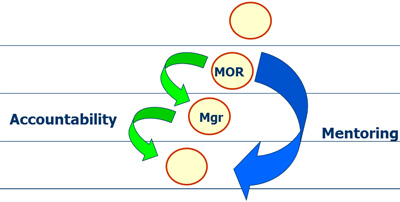
“It is NOT the accountability of a manager ‘to find and build a person as your replacement’ – that is the accountability of a manager’s manager, the Manager-once-Removed (MoR). Immediate managers are to be held accountable to coach subordinate employees ‘in role.’ MoRs are to be held accountable to ‘mentor’ subordinates-once-removed (SoR) related to career planning and potential advancement. MoRs should be held accountable to

  • learn if SoRs seek advancement, and
  • judge their future potential capability to determine if one could, in fact, have the requisite capability to work at a higher level.

And the manager of MoRs should hold MoRs accountable to do this work.
Here is a diagram of those relationships.
MOR-Mentor
My thanks to Kevin Earnest for paying attention and clarifying.

No Voodoo, No Amateur Psychology

“What is the Time Span capability required in my sales people?” Dennis asked.

“Sucker-punch question that will lead you down the wrong path,” I replied.

“Not sure I understand?” Dennis quizzed.

“Define the Level of Work, then ask if your salespeople are effective at that work.

“Not sure I understand the difference. Don’t we get to the same place?” Dennis pressed.

“I don’t think so,” I surmised. “Trying to determine the Time Span capability in a person prompts us to play amateur psychologist.”

Dennis mulled over the thought, so I continued.

“Identifying the Level of Work in the role is the work of a manager. Evaluating the effectiveness of the person we have assigned to this role is the work of a manager. There is no voodoo, no amateur psychology.”

The Sucker Punch Question of Org Charts

From the Ask Tom mailbag –

Question:

I was in your Time Span presentation about Elliott Jaques and Managerial Relationships. I recently discovered that our perceived organization chart is quite different that the one I had or felt was in place. I had all of my managers draw their view of our Org Chart so I can get a better grip on the disconnect. What is the best way to create the most accurate Org Chart and most importantly, implement it?

Response:

Interesting that Elliott faced this same dilemma. He described these various versions of the Org Chart this way –

  • Manifest Org Chart – this is the published version
  • Assumed Org Chart – this is the version that different people assume, as many versions as you have people. This is the version you received from your managers.
  • Extant Org Chart – the way the Org Chart actually works, based on observations and interviews. This would include all the dysfunction, vagaries, dotted lines, stupid rules, end arounds and general mayhem.
  • Requisite Org Chart – the design of managerial relationships based on Requisite principles.

When we put Org Charts together, we think the central question is “who reports to whom?” This is a sucker punch question that leads us astray. It is not a matter of “who reports to whom?” but a matter of “which manager is accountable for the output of which team or team member?”

A manager is that person in the organization held accountable for the output of their team. So, when I examine any role, it’s not a matter of who that role should report to. When I examine the role, it’s a matter of which manager is accountable for the output of this role.

This subtle shift is a game-changer. The Organization Chart is a visual depiction of managerial accountability, not “who reports to whom?”

But your question is how best to create this visual depiction. Ultimately, all crumbs lead to the top. I hold the CEO accountable for the design of the work. But the detail of this design is best hashed out in a series of meetings considering these questions –

  • What is the work to be done, tasks to be completed?”
  • What is the Level of Work?
  • What role is best to complete the tasks?
  • Which manager is accountable for the completion of those tasks (output)?

Very interesting questions.