Author Archives: Tom Foster

About Tom Foster

Tom Foster spends most of his time talking with managers and business owners. The conversations are about business lives and personal lives, goals, objectives and measuring performance. In short, transforming groups of people into teams working together. Sometimes we make great strides understanding this management stuff, other times it’s measured in very short inches. But in all of this conversation, there are things that we learn. This blog is that part of the conversation I can share. Often, the names are changed to protect the guilty, but this is real life inside of real companies.

Placing Accountability

From the Ask Tom Mailbag:

Question:
I have an IT person, very skilled in technology, but seemingly unable to look beyond next week. He is brilliant at solving network issues, working around this problem and solving that issue. But his backlog of projects is growing. It appears he is unable to prioritize or track progress on any project longer than one or two days. We have temporarily assigned him to report to one of our senior managers, she’s very organized, to try to keep him focused. Together, they have created tracking spreadsheets, and meet once a week to update the status on projects. But the more time goes by, the more out of control things get. The value we deliver to our clients depends on our technology, so this truly has my attention.

Response:
If this role was simply to keep your computer network afloat, wouldn’t be a big deal, but you describe this as mission critical. You describe requirements for two distinct roles. One role is technical, directly performing task assignments (direct output), and one role making decisions about priorities, sequence and allocation of resources. You might find both in the same person (if you had the budget), but that is not the case. You have two individuals, which you describe as competent.

Here’s the rub. Who is the manager of the IT person. Like many companies, computers and their networks are so mystical that IT personnel are allowed to roam free, with only vague accountability. The evidence of vague accountability, is that they often have no appropriate manager.

You described that you have a senior manager available, AND you will have to determine their interest in being the manager of the IT person, but here is the difference. Your move is to shift accountability to this senior manager. It is not a matter of the IT person reporting to this senior manager, but this senior manager being accountable for the direct output of the IT person.

This subtle shift in accountability makes all the difference. You see, I don’t know if they need to meet once a week or twice a day. That’s not my decision. That is a decision for the senior manager. And the senior manager will only make the right decision with the understanding that she is accountable for the output of the IT person. This is a game changer.

With New Eyes

From the Ask Tom Mailbag:

Question:

I listened with great interest to your presentation on Time Span. Intriguing. But where do we start? Specifically, where does a small company start?

Response:

It’s difficult for me to understand what you understand about Time Span, so let’s start from this basic fundamental. Time Span comes from the inside kernel of every goal. A goal is a “what, by when?” It is the “by when?” (Time Span) that gives us insight into the complexity of the goal (task assignment).

And so, that’s where I start. As a manager, if I can more clearly understand the complexity of the task assignment, I can more clearly understand the capability required to be effective in that role. The biggest mistake most managers make is underestimating the capability required for effectively completing the task.

It’s all about the work. That’s where I start.

It starts with the Role Description, examining the task assignments, the accountabilities inside the role. I know this sounds like managerial fundamentals, and it is. But managerial fundamentals with new eyes.

My Decision, Your Decision?

From the Ask Tom mailbag:

Question:
What are your thoughts on management that attempts to be so effective with controls that they create an element of fear within employees – paralyzing them when it comes to making independent and discretionary decisions? A side effect of that is when questioned, explanations are seen as being defensive rather than attempting to communication future solutions.

Response:
Some companies, some managers believe that, inside every task assignment, all duties are meticulously prescribed by the manager and all decisions are reserved for the manager. This belief is naive and if enforced, will fossilize the organization into rigid inaction. If every decision is reserved for the manager, normal workflow will become bottlenecked at that point, pressure will build and something will break. Managers cannot be everywhere at every moment, even managers have to sleep.

Managers (organizations) fall into this trap because they have little (or no) understanding of the difference between prescribed duties and discretionary duties. Understanding this difference, measured in Time Span begins the journey to effectiveness, for the manager, for the organization.

Prescribed duties are easy to understand. Prescribed duties are part and parcel of every task assignment. Where there are prescribed duties, there are few (or no) decisions surrounding the task. But every task carries some discretionary duties. It is those discretionary duties (discretionary decisions) that are appropriately placed in the hands of the team member. So, what’s the difference, between prescribed duties and discretionary duties?

A technician running a CNC machine (cutting metal) may have the prescribed duty to cut ten pieces of metal according to specification prior to noon. That task is prescribed, no discretion.

However, if the machine begins to make an abnormal noise, we have to depend on the discretion of the technician (not the manager) to shut the machine down. And not all abnormal noise requires the same decision. The technician, knowing the noise, may need to shut the machine down immediately, after the current cut or at the end of the shift. It is a discretionary decision based on the noise.

So, the prescribed duty, ten pieces, according to spec, cannot be modified by the technician. Shutting the machine down, based on an abnormal noise, is absolutely within the discretion of the technician.

When managers understand this difference, magic begins to happen.

No Buttons

I was saddened late last night, as I stepped off a plane from New York, to learn that Steve Jobs had passed away. As a student of business, I always regarded him as one of the great teachers.

Perhaps today, I will find a shirt with no buttons and wear it in his honor.

Supervisor vs Manager

From the Ask Tom mailbag:

Question:
Can you more clearly define the role of a Supervisor versus that of a Manager?

Response:
It can be confusing to nail down what one company defines as a Supervisor vs what another company defines as a Manager. Part of the problem talking about management issues, we don’t have a precise language. We talk using one set of words and others listen using another set.

Elliott Jaques (Requisite Organization) provides helpful direction by specifically describing and measuring the level of work using Time Span.

When I talk about the role of a Supervisor, I am looking for longest Time Span task assignments that can reasonably be completed between 3-12 months. The activities I would describe for that role are coordinating in nature, scheduling people, materials and equipment, tracking progress toward project milestones, solving logistical problems, using discretionary judgment within limits set by their manager. The value add of this role is accuracy, completeness and timeliness.

When I talk about the role of a Manager, I am looking for longest Time Span task assignments that can reasonably be completed between 12-24 months. The activities I describe for that role are planning, sequencing, system creation, system monitoring and system improvement. The latitude of their discretionary judgment is broader (also defined using Time Span). The value add of this role is consistency and predictability of results (achieved by systems).

Complexity and Time Span

From the Ask Tom mailbox:

Question:
You said that Time Span could be used to measure complexity. Not sure I understand the connection?

Response:

There are two kinds of complexity in the world. Time Span can be used to measure one of them.

The first kind of complexity is detail, detailed complexity. This is the world of engineering. Computers are useful in managing detailed complexity. Lots of moving parts.

But there is another kind of complexity, more difficult to deal with. It is the uncertainty in the future. And the further something is, out in the future, the more uncertain it is.

If you have a project that must be completed by tomorrow, the level of uncertainty is small. You will only be using materials on hand, working with people you already know, with guidelines that are already nailed down, because the project must be completed by tomorrow.

If you have a project that will take 24 months to complete, all kinds of things can change between now and the project due date. The material you intended to use may no longer be available when you need it. The people you work with now may be different than the people you work with next year. And the guidelines you have in your hand now, will most definitely change between now and 24 months from now.

The complexity of a one day task assignment versus a 24 month task assignment can be calibrated by simply measuring the Time Span of the due date.

What to Keep, What to Delegate?

From the Ask Tom mailbag:

Question:
Knowing that Time Span is part of who we are but also develops with maturity, is there anything a manager can do to help a team member develop his/her highest potential Time Span?

Response:
If you remove the words Time Span from your question, we have an age-old managerial quest, how to develop team members to their fullest potential?

Conceptually, Time Span gives us a way of measuring complexity related to a task assignment. In what ways can a manager help (influence, cajole, coach) a team member to develop their Applied Capability to more effectively complete task assignments?

Here’s my general advice. If you want to develop a person (or a team), give them a real problem to solve. Exercises, ropes courses, contrived case studies fit nicely in MBA programs, but there is nothing like a real problem to stimulate real growth.

Beginning managers know they need to delegate, so they pick off pieces of usually meaningless, make-work stuff and pass it off, keeping the tough stuff, the meaningful stuff for themselves. In the beginning of a manager’s career, deciding what to keep and what to delegate is a difficult decision.

Time Span is the measuring stick to help a manager make that decision. Inspecting the “by when” of a task assignment gives us insight into the complexity of that task. Developing a team member is a process of assigning increasingly complex Time Span task assignments. Paying attention to the Time Span of tasks gives a manager a way of organizing the developmental process. It makes coaching more scientific.

Nature or Nurture?

From the Ask Tom Mailbag:

Question:
When you talk about Time Span, you say you use Time Span as a measure of capability. Is Time Span something we are born with? Can it be changed? In other words, is it nature, or nurture?

Response:
Is it nature or nurture? Yes.

There are really two related issues. One issue is Maximum Capability, the other is Applied Capability.

Maximum Capability is what it is. Nature. Cannot be changed. Full potential. The problem with Maximum Capability is that it is difficult, nigh impossible to identify. We can’t see it.

What we can see, is Applied Capability. Why can we see it? There is evidence, work product, observation of behaviors, completion of tasks and judgments of effectiveness. We can see Applied Capability. And yes, there is almost always a difference between Applied Capability and Maximum Capability. We rarely work at our full potential.

Can we, as managers, have an impact on Applied Capability? To influence a person to work to their full potential, to their Maximum Capability? Yes.

There are several reasons that a person may work below their Maximum Capability. They may not have a required skill. As their manager, we might send that person to training. What happens to Applied Capability when a person now possesses the skill? It goes up.

This team member, having completed the training, may decide to go back to school. What happens to Applied Capability when a person engages in educational activity? It likely goes up.

As the manager, you place the team member in a role, with work on which they place a high value, work for which they have interest, passion. What happens to Applied Capability?

This interest in Maximum Capability is often a fruitless quest. We can’t see it, so what’s the point? But, we, as managers can have a dramatic impact on Applied Capability. That’s where I spend my time.

A Peer Group Can Help

From the Ask Tom Mailbag:

Question:
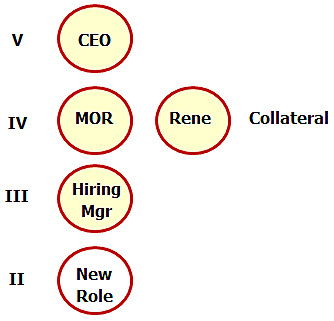
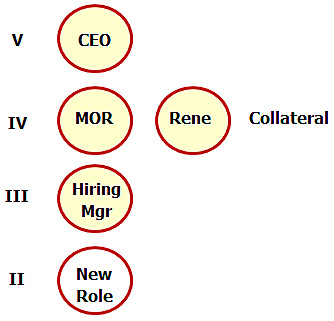
In the hiring process, if I am in a Stratum V role, engaged in hiring a Stratum IV VP, that makes me the hiring manager. Since I am at the top of the food chain in our company, who is the Manager Once Removed? Do I hire a consultant or a head hunter to help me.

Response:
Heavens no. With all due respect to the consulting community, most come to the table with limited insight into your company. They don’t know you, your limitations, your blind spots, your soft spots, your focus.

This is a shameless plug for peer groups, my favorite is an organization called Vistage. Self-described, a peer group consists of a group (of peers) with similar roles, who meet on a regular basis to kick the can around. It is those other people who sit around the table, who can be valuable in your hiring process for Executive Managers. Your peers, in their own organization, have similar accountabilities, likely, similar capability to you, and yet, do not wear your blinders. This outside objectivity may provide the critical insight, to bring value to the decision you are about to make in the hiring process.

Make no mistake, this is still your decision. You are the one who has to live with it.

Happy or Miserable

From the Ask Tom Mailbag:

Question:
When you talk about the role of the Manager Once Removed in the hiring process, you are right, it sounds like a lot of work. I am afraid I will get push-back from my management team, when I try to tell them they will have to be more involved in the hiring process.

Response:
I am not afraid you will get push-back. I know you will get push-back.

Most MORs tell me they are too busy to work with their Hiring Managers on mundane things like role descriptions, that is beneath them to do first pass on resumes. They tell me they are too busy with management issues and motivation issues.

My response is, “What more important thing do you have than to build the infrastructure of your team?”

The reason most MORs are so busy with their management issues is that they did a poor job of this in the first place, or rather, they allowed a poor hiring decision to be made by the Hiring Manager. MORs who do a good job of this will have wonderful lives as managers. MORs who do a poor job of this will be miserable for a very long time.