Category Archives: Timespan

Production of Software Code

From the Ask Tom mailbag –

Question:
I understand the concept of Time Span as it relates to a manufacturing environment, based on the the examples you used in your workshop. Our company is a software company, we write code, software as a service based in the cloud. Having trouble translating Time Span to this model.

Response:
The first piece of translation is to calibrate your production activity. In a manufacturing environment, production (individual direct output) is most often calibrated as a Stratum I role (Time Span tasks – 1 day-3 months).

Software programming (production of software code) requires a higher level of capability. Task assignments to write code that produce specific software functions, appear to fall within a short Time Span. A coding project might take two weeks to construct, code, de-bug, and test. Seems like a short Time Span task. But in the role of a programmer, the longest Time Span task (which calibrates the complexity of the role) may have less to do with programming and more to do with learning.

I often ask programmers, if you stopped learning about new routines, new programming objects, how long would your code be effectively written, current with the state of the art. The joking response is five minutes, but the real answer is somewhere between three months and one year. It’s not that their published code would stop working, but there are more efficient routines and ways of manipulating code invented every day. Time frame to obsolescence is somewhere between three months and one year.

A good example of this is the move to HTML 5. HTML 5 solves the current dilemma in the way video is handled on the internet, particularly with mobile computing, in a dispute between Apple and Adobe. Adobe would like all video to be handled using its Flash player, Apple says HTML 5 makes the flash player obsolete (and refuses to support it in their iPad and iPhone products). It will take some time for adoption of HTML 5, but programmers are having to learn its new routines. A year from now, programming code that ignores HTML 5 will still work, but fall short of generally accepted programming standards. So, the longest Time Span task, for a programmer, is not necessarily producing code, but continuously learning about new developments in code construction, requires minimum Stratum II capability (cumulative processing).

But writing code is not the whole story. A simple stand-alone function is useless. Software typically contains hundreds of functions collected together in a system that creates value for the user. Stringing those functions together requires Stratum III capability, a serial state of thinking. So, you may have programmers, but somewhere in your personnel mix, you will have a manager, also likely a skilled programmer, who decides how the functions are put together.

But a software system is not the whole story. Software systems, to be truly valuable are integrated with other software systems, with interoperability hooks, not only among internal software systems, but external software systems, like Facebook and Twitter. This integration will likely require a manager with Stratum IV (parallel processing) capability.

All of this discussion centers around production. Software companies have other disciplines which must also be integrated, like sales and customer service. Effectively integrating those systems into the mix requires Stratum IV and Stratum V capability.

Levels of work
Stratum IV – Parallel processing
Stratum III – Serial processing
Stratum II – Cumulative processing
Stratum I – Declarative processing

Over-Confidence

From the Ask Tom mailbag –

Question:
What do you do when a person wants a job that, as their manager, you KNOW is beyond their capability?

Response:
A false sense of his own skill level is not such a bad thing. Between you and me, let’s call it self-confidence, perhaps over-confidence. Some managers may try to adjust a person’s over-confidence by calling them out, chopping them off at the knees or otherwise belittling them. Waste of time. In fact, counterproductive.

Marcus Buckingham, in his book, The One Thing You Need to Know describes a superb managerial response. He assumes that, in some cases, over-confidence may actually be helpful in the face of a true challenge. So, rather than try to adjust this young man’s confidence level, spend time asking him to articulate the difficulties of doing a high quality job in his role with the company.

Most people underestimate the real difficulties, which contributes to over-confidence and also contributes to under-performance. Don’t cut this person off at the knees. Talk about the work. It’s all about the work. Your job, as a Manager is to help the person explore those difficulties.

Stunted Growth

From the Ask Tom mailbag –

Question:
In your Time Span workshop, you say that people max out during their lifetimes, related to capability. Can a person’s situation stunt growth so the individual can never grow to their maximum potential?

Response:
Happens all the time. Sometimes, those factors are internal, some external. Elliott Jaques, Requisite Organization, now available from Amazon, identified these factors as critical to success. Any of these could be a deal-breaker, preventing success. Any of these factors can have an impact on a person’s applied capability related to maximum potential.

  1. Skill – without a specific skill, I may not be able to reach my potential. If you are my manager and you recognize this, you would likely send me to training.
  2. Interest, or passion for the work – I will be interested in or passionate about work on which I place a high value. If I place a high value of a type of work, it is likely I will be interested or passionate about it. If I do not place a high value on a type of work, it is likely I will NOT be interested or passionate about it. If you are my manager, we will talk about values and you will most likely place me in a role with work on which I place a high value.
  3. Reasonable behavior – comes in two flavors, one is positive, one is dark. The positive side of reasonable behavior is my habits. There are habits I have, that contribute to my success, there are habits I have that inhibit my success. My habits will contribute or inhibit the application of my ability. If you are my manager, we will talk about my habits.

    The dark side of reasonable behavior, Elliott described as Minus-T. The “T” stands for Temperament. Most psychometric assessments attempt to tie specific behaviors to temperament. These instruments will typically divide behaviors (temperament) into four quadrants and assign a letter or color to designate that temperament. While Elliott observed no positive correlation any “normal” temperament, he did observe that an extreme negative temperament could be a deal killer for success. Extreme negative temperament might relate to elements like defensiveness or arrogance.

Any of these factors can get in the way. Some may have internal causes, others external. AND I expect the manager to pay enough attention to tell the difference.

Production in a Professional Service Firm

From the Ask Tom mailbag:

Question

In your workshop, you use a manufacturing business model to illustrate the levels of work. How does that translate for a professional service organization?

Response

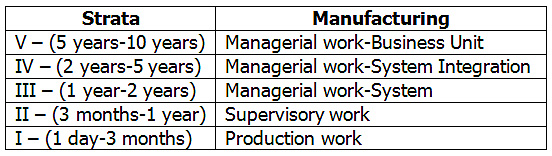
I use a manufacturing model because most of us can remember that video clip at Ford Motor Company, with automobiles coming down the assembly line. It is a quick picture for production work in a manufacturing environment. With that in mind, here is a typical table describing levels of work. The time frame designates the longest Time Span task associated with the role. In manufacturing, most production work falls easily into Stratum I.

Levels of Work

Levels of Work

In other business models, like professional service firms, production work (direct output to the customer) may be more complex and require a higher level of capability to effectively complete that work. Supervisory work and managerial work remains the same, it is the shift in the complexity of production work that changes.

For example. A patent case in a law firm, production work (direct output to the customer) might necessarily be done at Stratum III, IV or even V, depending on the complexity of the case. We can measure that complexity using Time Span as our calibration. A patent case still unresolved after five years of litigation might necessarily have required Stratum V capability to effectively deal with the uncertainty in the case.

In a CPA firm, tax production work might effectively be performed at Stratum III. Tax code is typically nailed down in 12 month increments. How a company might prepare for the tax/penalty implications of Obamacare might require Stratum IV capability (2-5 year decisions) to effectively make the right choices.

In summary, the levels of work in a professional service firm will hinge on the complexity of its production (direct output to the customer), and most often, that complexity shifts production toward higher Stratum capability.

The Noble Sound of a Bonus

“And what else?” I asked.

“This is a tough one,” she started. “Our bonus system. I think our bonus system is causing some of the problems.”

“How so?”

“Well, we wanted to make sure we didn’t get into lawsuits based on construction defects, so we pay a bonus to our engineering manager when we have zero claims. It sounds noble, but that sets up someone to over-work against our operations manager, who is just trying to get the job done.

“To make matters worse, we diligently work the project schedules to avoid delay claims. Delay claims can do more than suck the profit out of a job. So we pay a bonus to our operations manager when we have zero delay claims.

“So, now I have two people on the same team who are working against each other.”

“What else?”

Alicia began with a blank stare, then a hint of something in her mind. “I think,” she replied, “the worst part about our bonus system is that it creates mistrust.”

With New Eyes

From the Ask Tom Mailbag:

Question:

I listened with great interest to your presentation on Time Span. Intriguing. But where do we start? Specifically, where does a small company start?

Response:

It’s difficult for me to understand what you understand about Time Span, so let’s start from this basic fundamental. Time Span comes from the inside kernel of every goal. A goal is a “what, by when?” It is the “by when?” (Time Span) that gives us insight into the complexity of the goal (task assignment).

And so, that’s where I start. As a manager, if I can more clearly understand the complexity of the task assignment, I can more clearly understand the capability required to be effective in that role. The biggest mistake most managers make is underestimating the capability required for effectively completing the task.

It’s all about the work. That’s where I start.

It starts with the Role Description, examining the task assignments, the accountabilities inside the role. I know this sounds like managerial fundamentals, and it is. But managerial fundamentals with new eyes.

Complexity and Time Span

From the Ask Tom mailbox:

Question:
You said that Time Span could be used to measure complexity. Not sure I understand the connection?

Response:

There are two kinds of complexity in the world. Time Span can be used to measure one of them.

The first kind of complexity is detail, detailed complexity. This is the world of engineering. Computers are useful in managing detailed complexity. Lots of moving parts.

But there is another kind of complexity, more difficult to deal with. It is the uncertainty in the future. And the further something is, out in the future, the more uncertain it is.

If you have a project that must be completed by tomorrow, the level of uncertainty is small. You will only be using materials on hand, working with people you already know, with guidelines that are already nailed down, because the project must be completed by tomorrow.

If you have a project that will take 24 months to complete, all kinds of things can change between now and the project due date. The material you intended to use may no longer be available when you need it. The people you work with now may be different than the people you work with next year. And the guidelines you have in your hand now, will most definitely change between now and 24 months from now.

The complexity of a one day task assignment versus a 24 month task assignment can be calibrated by simply measuring the Time Span of the due date.

What to Keep, What to Delegate?

From the Ask Tom mailbag:

Question:
Knowing that Time Span is part of who we are but also develops with maturity, is there anything a manager can do to help a team member develop his/her highest potential Time Span?

Response:
If you remove the words Time Span from your question, we have an age-old managerial quest, how to develop team members to their fullest potential?

Conceptually, Time Span gives us a way of measuring complexity related to a task assignment. In what ways can a manager help (influence, cajole, coach) a team member to develop their Applied Capability to more effectively complete task assignments?

Here’s my general advice. If you want to develop a person (or a team), give them a real problem to solve. Exercises, ropes courses, contrived case studies fit nicely in MBA programs, but there is nothing like a real problem to stimulate real growth.

Beginning managers know they need to delegate, so they pick off pieces of usually meaningless, make-work stuff and pass it off, keeping the tough stuff, the meaningful stuff for themselves. In the beginning of a manager’s career, deciding what to keep and what to delegate is a difficult decision.

Time Span is the measuring stick to help a manager make that decision. Inspecting the “by when” of a task assignment gives us insight into the complexity of that task. Developing a team member is a process of assigning increasingly complex Time Span task assignments. Paying attention to the Time Span of tasks gives a manager a way of organizing the developmental process. It makes coaching more scientific.

Tasks and Sub-tasks, Calibrating Time Span

From the Ask Tom mailbag:

Question:
Are there roles with KRAs (Key Result Areas) in multiple strata?

Response:
Of course. Every role has Time Span task assignments all over the place. When we define that a role requires a specific Stratum capability, (this is a Stratum III role), we have identified that the longest Time Span task is between 12 and 24 months.

But Stratum III roles will contain Stratum II (3-12 months) and even Stratum I (1 day-3 months) task assignments.

If I am a Manager at a CPA firm, Stratum III capability required, I still have to complete a time sheet each day (Stratum I task). I will do my best to minimize the time required, use available technology, but at the end of the day, it’s my time sheet.

I may also be accountable for scheduling staff on specific projects (Stratum II capability required). For this task, I will do my best to minimize the time required, use available technology AND identify the sub-tasks that can be delegated to team members. Indeed, I may have a supervisor (Stratum II role) that I can delegate the entire task to, yet at the end of the day, I am accountable for scheduling staff.

We calibrate the Stratum capability required in a role by identifying the longest Time Span task assignment.

Production in a Professional Services Firm

From the Ask Tom mailbag:

Question:
When you talk about the various roles in the organization, you say that Stratum I roles are typically involved in production. And you also said that in some business models, production roles were calibrated differently? We have a CPA firm.

Response:
Regardless of the business model, regardless of the job title or description of the role, the calibration comes from inspecting the Time Span of the task assignments within the role. In a typical CPA firm, you could see these roles.

  • Clerical (word processing, spreadsheet, document assembly)
  • Preparer (bookkeeping, tax return)
  • In-charge (reviews preparation, coordinates task assignments in the client account)
  • Manager (reviews the in-charge’s review, determines which task assignments apply to a client account)
  • Partner (reviews the manager’s review, creates and maintains client relationship)

Each of these roles participates in production, yet the Time Span of their tasks is very different.

Preparer – production activities include the direct output from accounting tasks, return preparation. This would typically require Stratum II capability. While the observable mechanical activity for a monthly compilation (financial statement) appears to take less than one month, the impact of the work carries through to the annual financial statement. Stratum II (3 months – 12 months).

In-Charge – reviews the preparer’s work, stage one review, looking for mathematical errors, misapplied calculations, omissions. The In-Charge operates as a supervisor, making sure all work is completed, accurately in a timely manner. This work likely requires high Stratum II capability. Note – the In-Charge role is not a managerial role. The In-Charge is NOT the Preparer’s manager. The relationship between the In-Charge and the Preparer is a Cross-Functional relationship, Prescriber. Stratum II (3 months – 12 months).

Manager – reviews the In-Charge’s work, stage two review, looking for all required components. There is some final stage proofing on reconciliations to ensure accuracy, but the Manager’s review is looking for correct application of accounting methods (depreciation, accruals, reserves). This role is a managerial role, requiring Stratum III capability. The manager is likely the manager of both the Preparer and the In-Charge. Stratum III (1 year – 2 years).

Partner – reviews the Manager’s work, stage three review, looking for conceptual assumptions that fit within a multi-year treatment of the client’s business including loss-carryforwards, statutory interpretations, accelerations. This role requires Stratum IV capability (2 years – 5 years). There may also be direct production work related to bankruptcy, merger, acquisitions.

Regardless of the business model, regardless of the job title or description of the role, the calibration comes from inspecting the Time Span of the task assignments within the role.