Category Archives: Accountability

Avoid Schizophrenia

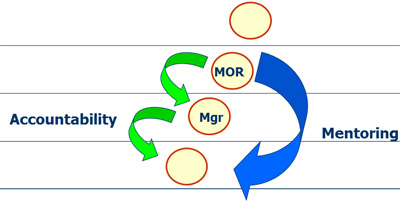
“So, the relationship between your supervisor (Vince) and production (Muriel) is all about effectivenesss. And that relationship is an accountability relationship,” I explained.

Sylvia nodded, so I continued, “What is the appropriate relationship between you, as manager, and production? What is the nature of the relationship for the Manager-Once-Removed?”

“It can’t also be an accountability relationship, because then production would have two bosses. That’s a little schizophrenic.” Sylvia’s head turned. “But the conversation I was having with Muriel wasn’t about production. I was interested in how she was doing as a person. I was interested in how she was adjusting, how she was finding things with the company.”

It was my turn to nod.

Sylvia continued. “As the Manager-Once-Removed, I think it is important to have those conversations. Her Supervisor will talk with her about production, making sure production gets done. My role, as a Manager, is to create the system, monitor the system. It’s important for me to find out the condition of the system.”

Mentoring

“Is it also your responsibility to be grooming your next wave of supervisors?” I asked.

“Yes, and my next supervisors are going to come from my best team leaders. As the Manager Once Removed, I need to be having conversations about career paths and opportunities within the company.”

“And, as a Manager, do you also have an accountability relationship with Muriel’s supervisor?”

“Yes, and I can find out a lot about Vince’s performance as a supervisor by having a Manager Once Removed conversation with Muriel.”

Accountability

“First of all, Sylvia, every company is a real company, even a company of three,” I replied. “As companies grow larger, the structure of how they work together becomes more complicated, for better or for worse.”

“Well, we have a good sized company,” Sylvia responded. “We have supervisors, managers, vice-presidents and a CEO. And we have an organizational chart.”

“So, let’s talk about those relationships and how they work best. A production worker talks to their supervisor. What is the nature of that relationship? What do they talk about?”

“They talk about problems,” Sylvia started. “Production problems, problems with the work.”

“Or successes with the work,” I picked up. “But their relationship is around the work. It’s all about the work. This reporting relationship is an accountability relationship.”

Sylvia nodded.

“Not as a Supervisor, but as a manager, when you have a conversation with a production worker, you are the Manager Once Removed. What is this conversation about? What is the nature of this relationship?”

Accountability

“That’s what Vince objected to,” Sylvia quickly protested. “I felt that it was an appropriate conversation, but when Vince objected, I didn’t know what to say.”

“That’s because Vince was wrong. What is the nature of the relationship of the Manager Once Removed?”

Would They Sit Around and Play Cards?

“I work because I have to work,” Vicki finally stammered.

“I will accept that,” I replied, “but not for the reasons you think.” A few seconds passed. “Are you happy with your work?”

“Well, yes. I mean, there are days when it’s frustrating, but mostly, I like the work.”

“And your team, do they like the work?”

Vicki winced. “Oh, I don’t know. It’s okay, I guess, but it’s hard work and if it were me, I don’t think I would like it.”

“Then why do they come to work every day?”

“Because they have to.”

“So, your team doesn’t like the work and the only reason they show up is because they have to? And do you think, if you left them alone all day, that instead of working, your team would sit around, play cards and take naps?”

Translating “Doing Your Best” to Real Life Results

From the Ask Tom mailbag: Kurt writes,

Question:
I think we all agree that employees should do their very best all day. But how do we measure/align this according towards our company’s deliverables? How do we translate doing your best towards real life results?

Response:
I can do my best and due to circumstances, the desired result may still not be achieved. I can also do less than my best, and due to circumstances, the desired result may nevertheless occur.

Real life results come from the decisions of the manager. It is the manager who decides appropriate resources and adjusts those resources according to circumstances. It is the manager who decides which tasks will be completed and given priority. If a team member’s best performance fails to net the result, it is the manager who should be held accountable for mis-estimating the effort required for success.

It has been my experience that most team members will always give their best.

When a team member fails to give it their best, due to a personal situation affecting the working behavior, I hold the manager accountable. Every manager should know every team member. They should know every team member’s spouse, and whether they play softball or go fishing on the weekends.

When a team member fails to give it their best, due to a poor working environment, I hold the manager accountable for the systems that created that environment.

When a team member fails to give it their best, because they are attempting to take advantage of the organization, violating their contract to do their best, I hold the manager accountable for identifying that behavior and taking steps to either correct it or remove the person from the team.

First Authority of the Hiring Manager

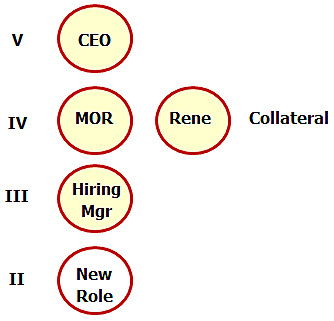
“So, it’s not me, but, Joe, who is supposed to motivate his team?” Alicia asked.

“No, that is not Joe’s role, as a supervisor,” I replied.

“Okay, so if he is NOT supposed to motivate his team, how IS Joe supposed to get the work done?”

“Alicia, when you hired Joe to be the supervisor, how did he put his team together?”

“Well, Joe had never really hired anyone before, so I helped him screen candidates and I made recommendations.”

“And what if Joe didn’t like your recommendation?”

“Well, Joe is an adult, and he had the final say. If there was someone he didn’t want on his team, I didn’t force him,” she explained.

“So, that’s the first answer to your question of how Joe is supposed to get the work done. While you (as the Manager Once Removed) may help and qualify candidates for his team, he has the authority to veto any appointment?”

“Yes,” Alicia nodded.

“And if, in his judgment, as a Supervisor, he feels that a team member is either not doing their best or that their best is not good enough to complete assignments, does Joe have the authority to deselect that person from his team?”

“Well, yes, I mean he can’t just fire someone, we have a process for that and it requires some approvals from HR and such.”

“But Joe has the authority to deselect someone from his team?”

Alicia continued to nod. “Okay, but there has to be more,” she coaxed.

How to Get a Different Result

Alicia was trying to make complicated sense out of this. “Each day, Joe’s team is required to show up for work and do their best,” she muttered. “I don’t get it. It’s too simple. What if we are not getting the results we want?”

“If Joe’s team shows up every day and does their best, what could they do to get a different result?” I asked.

“Well, Joe could have them do something different, reassign a route, load the trucks differently to make fewer trips, double check the load for missing items.”

“Exactly, but who is responsible for making those decisions and assigning those tasks?” I continued.

“Well, Joe is,” she replied.

“So, the team shows up and does their best. It is Joe who we hold accountable for the results of the team.”

Create Benchstrength in Your Candidate Pool

“You need to terminate five out of seventeen on your sales team?” I asked.

Roger took a deep breath. “Yes. And it doesn’t make them bad people. If anything, it makes me a bad manager. Intuitively, I knew they were not the right people for the role, but I allowed my judgment to become clouded, made up my own excuses for them.”

“How soon will you be making this change?”

“First, I have to find some people to cover the territory. No. I need to find some people capable of creating the kinds of relationships that generate sales.”

“What’s the biggest lesson from all this?” I prompted.

“I need to constantly be recruiting. I did not make the moves I knew I should have made, because I didn’t have a back-up to go to. Because I did not create the bench strength in my own candidate pool.”

The Clarity in Visual Banding

“Yes,” Roger nodded. “Grading my sales team into these six bands of effectiveness helps me see what to do next.”

“How so?” I prompted.

“The temptation is to keep all the people in the top half of the banding and terminate the people in the bottom half. But now I have more judgments to make, as a manager.”

“There’s more?” I pressed.

“Yes. I have one sales person, in the top of the top half, that needs leadership training. In another year, I want to move that salesperson into a more complicated product line, with a longer sales cycle.”

“And?”

“And,” Roger stopped. “And I need to terminate five out of the seventeen people I have on my team.”

“How did you reach that conclusion?” I asked.

“Again, it wasn’t difficult. I have been making excuses for their poor performance, sent them to training, tried to motivate them, offered a bonus. Once I did the analysis, it became very clear.”

Visual Insights to Make Your Moves

“Okay,” Roger continued. “I have seventeen salespeople and I charted each one. First, I made a judgment, based on my expectations in the role, and taking into account all the factors I know they are up against in the market, observing their behavior, watching their habits, getting feedback from the people they encounter. The judgment was simple. I judged whether they were as effective as someone in the top half of the role or the bottom half, and then in that half, whether they were in the top, middle or bottom.”

“I see you drew a picture,” I nodded. “Horizontal lines across the page, representing the six bands of effectiveness, and then a small circle for each of your salespeople.”

“Visually, it makes it easy to see the difference in effectiveness,” Roger explained. “And yet, there is enough detail to cover the nuances. Six grades of effectiveness is enough to let me see my sales team as a whole, where I have strength and where I have weakness.”

“As a manager, does this analysis give you insights on what moves to make?”

Six Bands of Effectiveness

“How do you tell?” Roger asked. “When we had to make decisions to lay people off, gosh, eighteen months ago, we thought we were choosing to keep our best people. Maybe, it’s just harder now. But some of the people we kept are not making the grade.”

“How do you explain their underperformance?” I pressed.

“Bottom line, I think they were successful, before, because things were easy. We made sales because people called us. No one had to knock on doors, ask for appointments, do needs analysis. My salespeople are clamoring for more leads, but they squander the leads we give them.”

“So, when you look at your team, how do you rate their effectiveness?”

“You mean, on a scale from 1-10, or A-B-C?”

“Think about it this way. Given what you expect in their role, are they operating as well as someone in the top half of the role or the bottom half of the role?”

“Well, each person is different,” Roger replied.

“Good. So, you can make that judgment for each of your salespeople?”

“Yes, absolutely. When you put it like that, it’s easy to see.”

“And then, in that half, are they as effective as someone in the top, middle or bottom of that half?”

“Again,” Roger was thinking. “I could do that for each salesperson.”

“So, you could make a judgment, as a manager, for the top half or bottom half, and then in that half, the top, middle or bottom. That creates six bands of effectiveness related to your salespeople.”