Yesterday, I posted a casual conversation about something I have observed as a fatal flaw in most organizations, the flaw is failing to think forward about succession. The biggest constraint to most companies is the lack of managerial talent. We get so tied up in getting production out the door, we forget about sustaining that momentum beyond the month, the quarter, the year.
In the posted conversation, I did not specifically describe where this accountability lies, nor its mechanics. In short order, I received an email from a colleague, clarifying the situation.
“It is NOT the accountability of a manager ‘to find and build a person as your replacement’ – that is the accountability of a manager’s manager, the Manager-once-Removed (MoR). Immediate managers are to be held accountable to coach subordinate employees ‘in role.’ MoRs are to be held accountable to ‘mentor’ subordinates-once-removed (SoR) related to career planning and potential advancement. MoRs should be held accountable to
- learn if SoRs seek advancement, and
- judge their future potential capability to determine if one could, in fact, have the requisite capability to work at a higher level.
And the manager of MoRs should hold MoRs accountable to do this work.
Here is a diagram of those relationships.
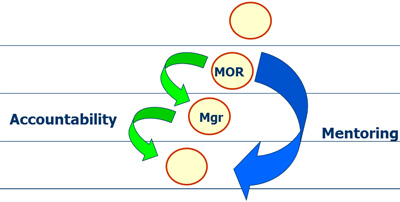
My thanks to Kevin Earnest for paying attention and clarifying.
This is the molecule that hold organizations together, and is healthy creates companies and employees that are able to work towards potential. When I share this idea many people nod their heads and agree. BUT when I try to put it into place there is fear and rejection. That is because the MOR and the manager may very well be too close.
I concur with Mr. Earnest. It is the MoR that must take responsibility for an effective organization below him or her. But your point is an important one, and the manager in your example should be coaching, training, and assessing the work performance of direct reports, and making sure that his/her manager is on the ball about promotional opportunities as employees mature in their cognitive abilities.
With regards to Mr. Cardus’ point, unfortunately too much head-nodding occurs in organizations, and not enough time is spent by managers carrying out their managerial responsibilities of creating more effective working environments conducive to pride of workmanship and a productive working environment.